
What Is a Bunion?
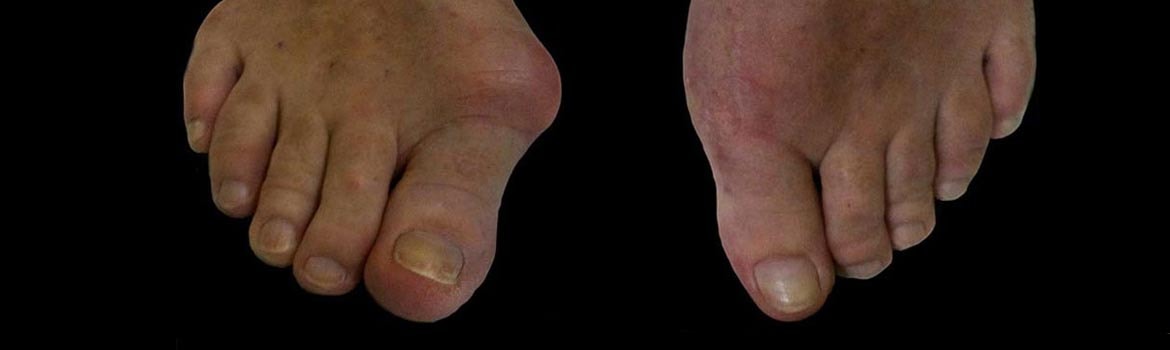
A bunion is often described as a bump on the side of the big toe. But a bunion is more than that. The big toe leans toward the second toe, rather than pointing straight ahead. This throws the bones out of alignment, producing the bunion’s “bump.”
Bunions are progressive, they don’t go away, and will usually get worse over time. But not all cases are alike, some bunions progress more rapidly than others. Osteoarthritis can develop in the big toe joint as the bunion worsens over time, causing increased pain and stiffness in the joint. Even though bunions are a common foot deformity, many people may unnecessarily suffer the pain of bunions for years before seeking treatment.
Causes of Bunions
Bunions are most often caused by an inherited faulty mechanical structure of the foot. It is not the bunion itself that is inherited, but certain foot types that make a person prone to developing a bunion. Footwear can cause pressure on the bump leading to pain, but do not actually cause the bunion.
Who It Helps
If non-surgical treatments fail to relieve bunion pain and when the pain of a bunion interferes with daily activities. The goal of surgery is the reduction of pain. A variety of surgical procedures is available to treat bunions. In selecting the procedure or combination of procedures for your particular case, Dr Ozan Amir will take into consideration the extent of your deformity based on the x-ray findings, your age, your activity level, and other factors.
Painful bunions that limit daily life
Surgery is for pain that interferes with daily activities after non-surgical care has been tried, not for the appearance of the bump alone.
Bunions with hammer toes
Often patients with hammertoe have bunions or other foot deformities corrected at the same time.
Bunions with arthritis in the joint
Where osteoarthritis has developed in the big toe joint, the x-ray findings shape which procedure is suitable. Ozan explains the difference at consultation.
What to Expect
Every surgical pathway follows the same four stages, and nothing is booked until you have the information to make an informed decision.
Assessment first
Ozan will obtain a thorough history and physical examination of your foot, and will correlate the findings with x-rays. You leave knowing whether surgery is appropriate and, if it is, which procedure or combination of procedures he recommends and why.
The treatment
Both traditional open and minimally invasive techniques are available. With minimally invasive foot surgery, a small incision is made in the patient’s skin and a specially designed instrument is inserted into this opening. The entire procedure is performed through this tiny opening. At the conclusion of the surgery, a small bandage protects the area. Which technique suits you depends on the extent of the deformity.
A short course
Recovery is a course of weeks, not days, and its length varies with the procedure or procedures performed. Manly Foot Clinic has not published a week-by-week bunion recovery timeline, so this page does not state one. Ozan gives you a timeline specific to your procedure in writing at consultation.
Review and progress
Structured review after surgery, outcome measurement and a report back to your referring practitioner. Orthotic therapy to address the underlying mechanics is available in the same clinic.
Why Consider Bunion Surgery at Manly Foot Clinic
- A surgical podiatrist consults and operates at the clinic. Bunion surgery and complex reconstruction of the forefoot are Ozan’s stated interest.
- Both open and minimally invasive techniques are available, so the recommendation is matched to the deformity rather than to one method.
- Assessment, x-ray review, surgery and orthotic follow-up all happen in the one clinic in North Manly.
- Serving the Northern Beaches since 1989.
What it costs
Consultation fees, including those for our surgical podiatrist, are published on our FAQ page. The surgical fee is not published; it depends on the procedure and the facility and is quoted in writing after your consultation.
Bunion Surgery FAQs
If non-surgical treatments fail to relieve bunion pain and when the pain of a bunion interferes with daily activities. The goal of surgery is the reduction of pain.
Bunions are progressive, they don’t go away, and will usually get worse over time. Non-surgical care can relieve pain, and footwear can reduce pressure on the bump, but it does not correct the alignment. Surgery is considered only when non-surgical treatments fail to relieve pain.
Reconstructive surgery corrects the structure of the foot when a deformity is causing ongoing pain or difficulty walking and non-surgical care hasn’t helped. That can mean realigning the bones of the big toe in a bunion, straightening severe or rigid hammer toes, or correcting deformity in the rearfoot, such as a collapsing flat foot. Each procedure is planned around your X-rays, how your foot functions and what you need to get back to. Dr Ozan Amir trained in podiatric surgery with the Australasian College of Podiatric Surgeons. He completed further surgical training in the United Kingdom and at the Podiatry Institute in Atlanta, where he focused on rearfoot reconstruction. Before any procedure is booked, you’ll be told what it involves, the expected recovery time and the risks.
The length of the recovery period will vary, depending on the procedure or procedures performed. Manly Foot Clinic has not published a standard timeline, so this page does not state one. Dr Ozan Amir gives you a written timeline for your procedure at consultation.
No, you can book directly without a referral. If you’d like, we’ll send a short report to your GP after your appointment so your foot care stays part of your overall health record. If your appointment is through a Medicare care plan, DVA or another funded program, you will need a referral, so check with us when you book.
Serving Manly and the Northern Beaches.
Manly Foot Clinic is at Shop 3/3 Corrie Rd, North Manly, NSW 2100. Patients come for bunion surgery from Manly, Dee Why, Brookvale, Freshwater and Balgowlah, and on referral from across Sydney. Open Monday to Friday 8:30am to 5:30pm and Saturday 8:00am to 2:00pm.