What is Achilles tendon pain?
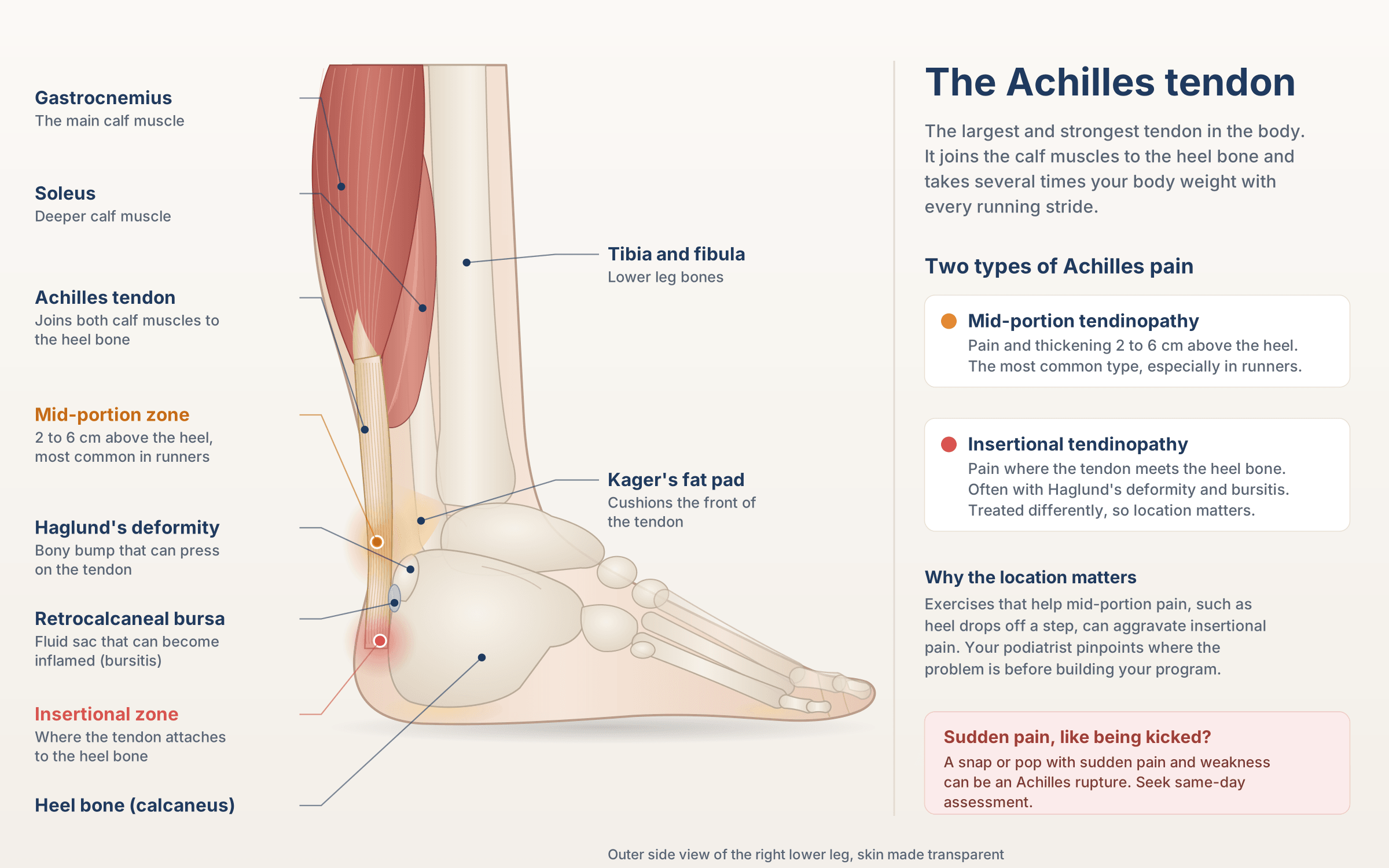
The Achilles is the thick tendon at the back of the ankle that joins the calf muscles to the heel bone. It’s the largest and strongest tendon in the body and takes several times your body weight with every running stride.
Most Achilles pain is Achilles tendinopathy. It develops when the load placed on the tendon outpaces its ability to adapt, so it becomes painful, stiff and sometimes thickened. Despite the old name “tendonitis”, the problem is usually a change in the tendon’s structure rather than inflammation, which is why rest and anti-inflammatories alone rarely fix it.
Two places it hurts, and why it matters
Mid-portion Achilles tendinopathy. Pain and often a tender, thickened area 2 to 6 cm above the heel. It’s the most common type, especially in runners.
Insertional Achilles tendinopathy. Pain right where the tendon attaches to the back of the heel bone. It’s often linked to a bony bump (Haglund’s deformity) and an inflamed bursa behind the tendon (retrocalcaneal bursitis), and is more common in less active and older people.
The two are treated differently. For example, calf stretches that help mid-portion pain can aggravate insertional pain, so getting the location right matters.
What causes Achilles tendon pain?
Achilles pain is usually a load problem, triggered by a change:
- Training changes. Running further or faster, adding hills or speed work, or increasing too quickly.
- Returning after a break. Getting back into sport after injury, illness or time off.
- Surfaces and footwear. A switch to harder surfaces, lower-heeled or minimalist shoes, or a stiff heel counter pressing on the tendon.
- Calf strength and flexibility. Weak or tight calves leave the tendon taking more of the load.
- Foot mechanics. Feet that roll in excessively can load the tendon unevenly.
- General health factors. Age, body weight, high cholesterol, diabetes and some medications, including certain antibiotics (fluoroquinolones), can increase the risk.
Symptoms to look out for
- Pain and stiffness in the tendon first thing in the morning, or at the start of exercise
- Pain that eases as you warm up, then returns after exercise or the next morning
- Tenderness when you squeeze the tendon
- Thickening, a lump or a bump at the back of the heel
- Pain or weakness when pushing off, rising onto your toes or going up stairs
- Rubbing or pain from the back of your shoes
Get urgent help if you feel a sudden sharp pain at the back of the ankle, as though you’ve been kicked, especially with a snap or pop and difficulty walking or rising onto your toes. That can be an Achilles rupture, which needs prompt assessment, ideally the same day, at an emergency department or with us.
How is Achilles tendon pain diagnosed?
Achilles tendinopathy is usually diagnosed from your history and an examination. Your podiatrist feels along the tendon to find exactly where it’s painful or thickened, tests calf strength and endurance (such as how many single-leg heel raises you can do), checks ankle and calf flexibility, and watches you walk and, if relevant, run. Where it would help, we arrange an ultrasound or MRI to check the tendon’s structure, look for a tear, or confirm a Haglund’s deformity or bursitis.
Stage 1: settle the tendon
- Modify, don’t stop. We adjust your training volume, pace, hills and surfaces so the tendon can settle while you stay active.
- Heel lifts to temporarily reduce the load on the tendon.
- Footwear changes. Avoiding low or flat shoes, and choosing a soft or low heel counter if the back of the shoe presses on the tendon.
- Isometric calf exercises (holding a heel raise position), which can reduce pain in the early stages.
Stage 2: rebuild strength
- A progressive loading program. This is the most effective treatment for Achilles tendinopathy. Calf and tendon exercises progress from slow, heavy heel raises to faster, springier exercises like hopping, which prepare the tendon for running and sport. For insertional pain, exercises are done on flat ground rather than off a step.
- Custom orthotics, made from a 3D scan of your feet, where foot mechanics are loading the tendon unevenly.
- A graded return to running and sport, with clear milestones to guide each step.
Stage 3: for pain that won’t settle
- Shockwave therapy. Non-invasive acoustic pulses that stimulate healing in long-standing Achilles tendinopathy, for both mid-portion and insertional pain, usually over a course of 3 to 5 weekly sessions.
- Ultrasound-guided injection for bursitis. Corticosteroid isn’t injected into the Achilles tendon itself, because it can weaken the tendon. Where an inflamed bursa behind the tendon is contributing, Dr Rohan Amir can place an injection precisely into the bursa under ultrasound guidance.
- Prolotherapy. For long-standing Achilles tendinopathy that hasn’t responded to a well-run loading program, Dr Rohan Amir can provide ultrasound-guided dextrose prolotherapy alongside your exercises. Unlike corticosteroid, it doesn’t weaken the tendon.
Stage 4: surgical opinion
If insertional pain, particularly with a Haglund’s deformity, continues despite several months of thorough treatment, Dr Ozan Amir, Surgical Podiatrist, can assess whether surgery is an option. Depending on the problem, this may include removing the bony bump and inflamed bursa, cleaning up damaged tendon and reattaching it to the heel bone, or lengthening a tight calf muscle (gastrocnemius recession) to reduce the strain on the tendon. Minor procedures are performed at the clinic, and more complex surgery in a day surgery hospital.
How long does Achilles tendon pain take to get better?
Tendons adapt slowly, so Achilles tendinopathy usually takes a few months to settle with a consistent loading program, often three to six months and sometimes longer for long-standing or insertional pain. Many people notice improvement within a few weeks of starting the right exercises. Sticking with the program after the pain eases is what stops it coming back. We set clear milestones and review dates, and step up treatment if progress stalls.
Achilles pain in children and teenagers
Pain at the back of the heel in active children aged around 8 to 14 is most often Sever’s disease, irritation of the growth plate where the Achilles attaches, rather than Achilles tendinopathy. It’s assessed and managed differently, so bring your child in for an assessment.
Watch Dr Ozan Amir explain
Anatomy of the Tendo Achilles Including the Peritenon
Surgical Correction of Haglund’s Deformity
Distal Gastrocnemius Recession – Anatomy and Surgical Procedure
My 10 Year Old Has Sever’s Disease
Achilles Tendon Pain FAQs
Usually not. Complete rest weakens the tendon further, and the pain often comes back as soon as you return to activity. A staged loading program lets the tendon recover while it gets stronger.
Morning stiffness and pain are classic signs of tendinopathy. The tendon stiffens overnight and usually eases as you start moving.
Often, yes, with changes. As a rough guide, pain during running that stays at a mild level (around 3 out of 10 or less) and settles by the next morning is usually acceptable. We’ll set your running plan at your assessment.
It depends where the pain is. Stretching can help mid-portion pain, but stretching over the edge of a step can aggravate insertional pain. Your podiatrist will tell you which exercises suit your tendon.
Corticosteroid isn’t injected into the Achilles tendon itself, because it can weaken the tendon and increase the risk of a tear. An ultrasound-guided injection may help when an inflamed bursa behind the tendon is part of the problem.
Usually a few months, often three to six, with a consistent loading program. Long-standing or insertional pain can take longer.
No, you can book directly. If your appointment is through a Medicare care plan, DVA or another funded program, you’ll need a referral, so check with us when you book.
Serving Manly and the Northern Beaches.
Manly Foot Clinic is at Shop 3/3 Corrie Rd, North Manly NSW 2100. We see patients from Manly, Balgowlah, Freshwater, Dee Why and Brookvale through to Mosman, Neutral Bay, Chatswood and the wider North Shore.