What is Haglund’s deformity?
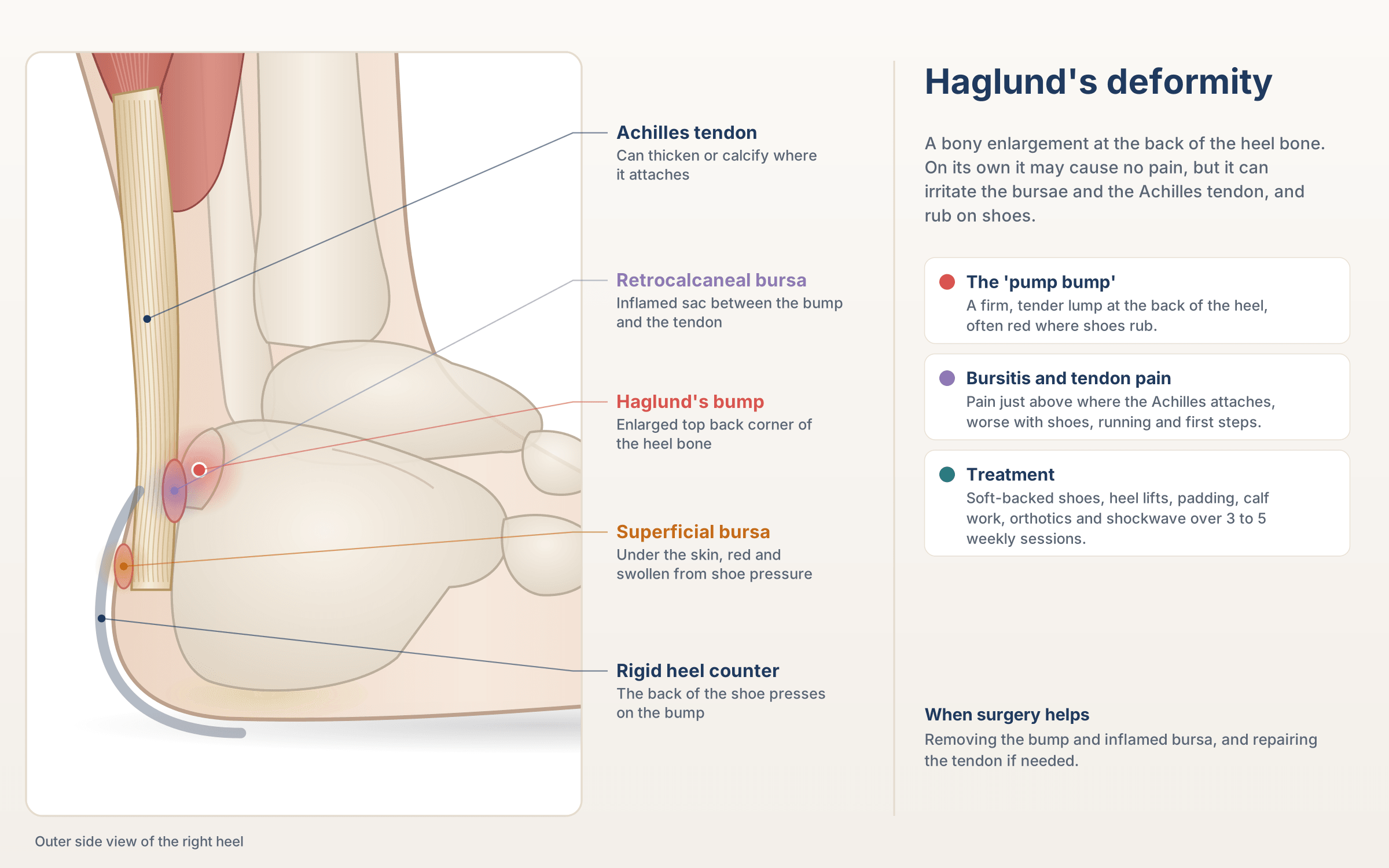
Haglund’s deformity is an enlargement of the bone at the back and top of the heel bone (the posterosuperior calcaneus), just above where the Achilles tendon attaches. On its own, the bump isn’t always painful. Problems start when it presses against the back of your shoes, or against the soft tissues around the Achilles tendon.
What it can lead to
- Retrocalcaneal bursitis: inflammation of the fluid-filled sac (bursa) between the bump and the Achilles tendon
- Superficial (adventitious) bursitis: an inflamed bursa between the bump and the skin, often red and swollen from shoe pressure
- Insertional Achilles tendinopathy: irritation and damage where the Achilles attaches to the heel bone
- Calcification within the tendon at its attachment
Together, these are sometimes called Haglund’s syndrome.
What causes Haglund’s deformity?
- Heel bone shape, which is often inherited
- High arches, which tilt the heel bone so the bump presses more on the tendon
- A tight Achilles tendon or calf muscles
- Rigid-backed shoes: court shoes, ice skates, work boots and some running shoes
- Walking on the outside of the heel
- Repetitive running and jumping
Symptoms to look out for
- A visible, firm bump on the back of the heel
- Pain at the back of the heel, especially in shoes with a stiff back
- Redness, swelling and tenderness over the bump
- Pain where the Achilles tendon attaches to the heel
- Pain when rising onto your toes, walking uphill or starting to walk after rest
- Blistering or callus over the bump from shoe rubbing
How is Haglund’s deformity diagnosed?
Your podiatrist will examine the back of the heel, feel for the bump and pinpoint which structures are painful: the bursa, the tendon or the skin. We’ll assess your foot structure, calf flexibility and footwear. X-rays show the shape and size of the bump and any calcification in the tendon, and ultrasound or MRI shows bursitis and the health of the Achilles tendon.
Non-surgical treatment
Non-surgical treatment can settle the pain and inflammation, but it won’t shrink the bump itself.
- Footwear: shoes with a soft or low back, or backless shoes, while it settles
- Heel lifts to change where the shoe rubs and reduce strain on the Achilles
- Padding: gel heel sleeves and pads to protect the bump
- Ice: 20 minutes at a time, with a cloth between the ice and the skin, and at least 40 minutes between applications
- Calf stretching and Achilles loading exercises, done on flat ground rather than off a step
- Custom orthotics, made from a 3D scan of your feet, especially for high arches, to change the heel position
- Shockwave therapy for insertional Achilles pain, usually over a course of 3 to 5 weekly sessions
- Ultrasound-guided injection into an inflamed bursa, provided by Dr Rohan Amir. Corticosteroid isn’t injected into the Achilles tendon itself.
- A walking boot, for a short period, for severe flare-ups
When is surgery needed?
If pain continues despite several months of thorough non-surgical treatment, Dr Ozan Amir, Surgical Podiatrist, can assess whether surgery is an option. Surgery may involve:
- Removing the bony bump (resection of the Haglund’s deformity)
- Removing the inflamed bursa
- Cleaning out damaged tendon and calcification at the Achilles attachment, and reattaching the tendon to the heel bone with anchors if needed
- Gastrocnemius recession to lengthen a tight calf muscle and reduce strain on the tendon
- A heel bone osteotomy, in some cases, to change the angle of the heel bone
Surgery is performed in a day surgery hospital. Recovery usually involves a period in a boot, followed by a gradual return to walking and a rehabilitation program. Ozan will explain the procedure, the recovery and the risks so you can make an informed decision.
Watch Dr Ozan Amir explain
Surgical Correction of Haglund’s Deformity
Adventitious Bursa – Discussion and Surgical Excision
Anatomy of the Tendo Achilles Including the Peritenon
Distal Gastrocnemius Recession – Anatomy and Surgical Procedure
Haglund's Deformity FAQs
No. Non-surgical treatment can settle the pain and swelling, but the bony bump stays. Surgery is the only way to remove it.
Shoes with a soft or low back, or backless shoes, while it’s painful. Avoid stiff heel counters that press on the bump.
They often happen together. Haglund’s deformity can irritate the Achilles tendon where it attaches, causing insertional Achilles tendinopathy.
It depends on what’s done. Most people spend several weeks in a boot, then gradually return to normal shoes and activity over the following months. Ozan will give you a timeline for your procedure.
No, you can book directly. If your appointment is through a Medicare care plan, DVA or another funded program, you’ll need a referral, so check with us when you book.
Serving Manly and the Northern Beaches.
Manly Foot Clinic is at Shop 3/3 Corrie Rd, North Manly NSW 2100. We see patients from Manly, Balgowlah, Freshwater, Dee Why and Brookvale through to Mosman, Neutral Bay, Chatswood and the wider North Shore.