What is tarsal tunnel syndrome?
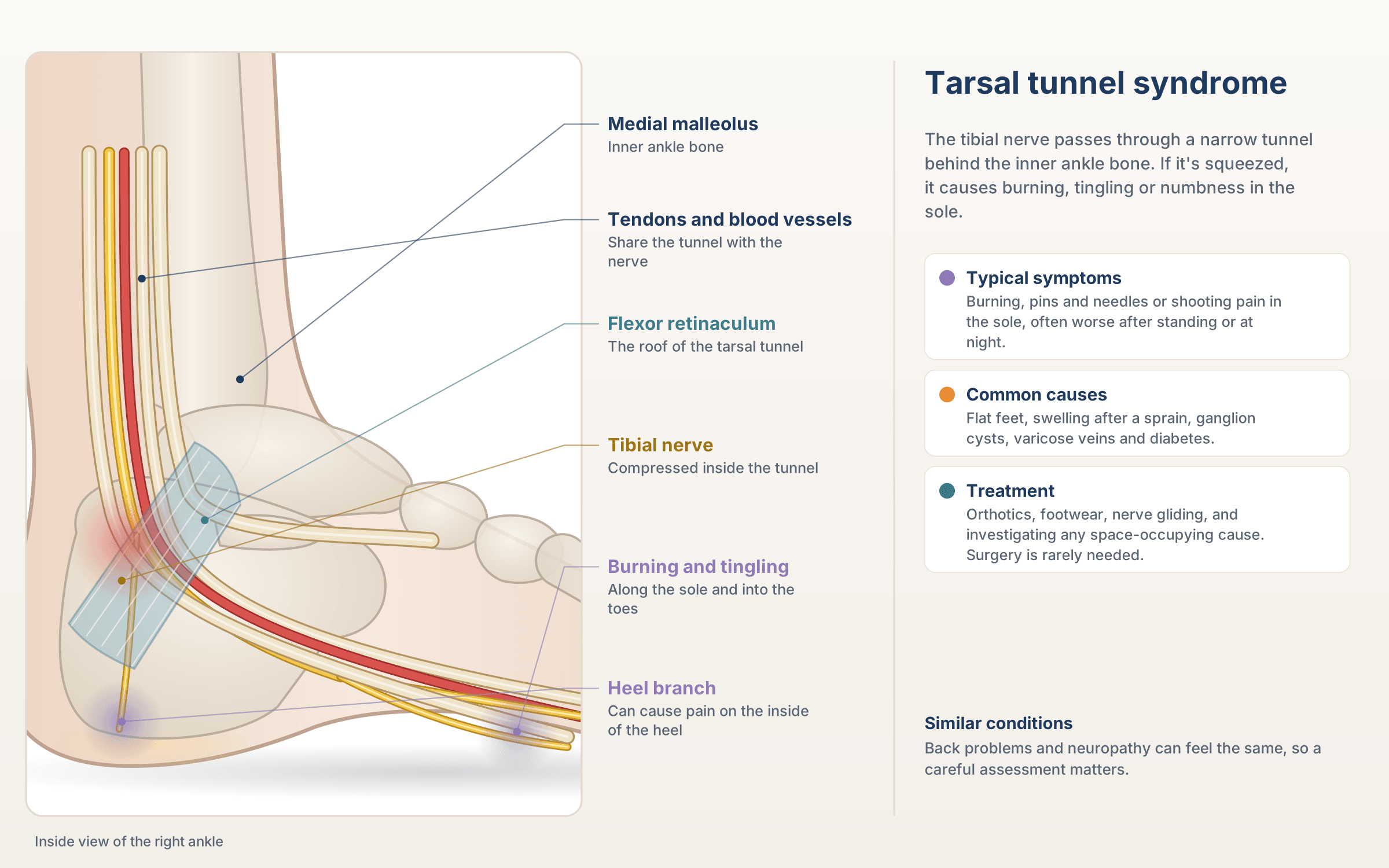
The tarsal tunnel is a narrow space on the inside of the ankle, behind and below the bony bump (the medial malleolus). It’s formed by the ankle bones on one side and a band of tissue called the flexor retinaculum on the other. Running through it are the tibial nerve, an artery and veins, and three tendons.
When something squeezes the tibial nerve inside the tunnel, or its branches just beyond it, the result is tarsal tunnel syndrome. The tibial nerve divides into the medial and lateral plantar nerves, which supply the sole, and the calcaneal branches to the heel, so symptoms can be felt in different parts of the foot depending on which branch is affected.
What causes tarsal tunnel syndrome?
- Flat feet or rolling in, which stretch and compress the nerve
- Swelling from an ankle sprain, fracture or tendon problem
- Space-occupying lesions: ganglion cysts, swollen veins (varicosities), lipomas, bone spurs or an extra muscle, such as an accessory flexor digitorum longus
- Scar tissue from previous injury or surgery
- Systemic conditions: diabetes, rheumatoid arthritis and hypothyroidism
- Repetitive activity and long periods on your feet
Symptoms to look out for
- Burning, tingling or pins and needles on the inside of the ankle, heel or sole
- Shooting or electric pain into the arch and toes
- Numbness in the sole of the foot
- Symptoms worse with standing, walking or at the end of the day
- Symptoms that can also be worse at night
- Pain that spreads up the inside of the calf
How is tarsal tunnel syndrome diagnosed?
Your podiatrist will examine the inside of the ankle, tapping over the nerve to see if it reproduces tingling (Tinel’s sign), and test sensation and strength in the foot. We assess your foot posture, how you walk, and look for swelling or lumps.
Because nerve pain can come from other places, including the lower back, we may arrange further tests:
- Ultrasound or MRI, to look for a cyst, swollen vein, extra muscle or other lesion pressing on the nerve
- Nerve conduction studies, arranged with a neurologist, to measure how well the nerve is working
Non-surgical treatment
- Custom orthotics, made from a 3D scan of your feet, to support the arch and reduce stretch and pressure on the nerve
- Taping to support the arch and reduce symptoms
- Footwear: supportive shoes that don’t press on the inside of the ankle
- Managing swelling with compression and elevation
- Nerve gliding exercises and calf stretching
- Activity changes while symptoms settle
- Ultrasound-guided injection around the nerve to reduce inflammation, provided by Dr Rohan Amir
- Medication for nerve pain, in consultation with your GP
Orthotics need careful prescription in tarsal tunnel syndrome, as poorly designed arch supports can sometimes press on the nerve and make symptoms worse.
Surgery
If symptoms persist despite thorough non-surgical treatment, or a lesion such as a cyst or extra muscle is compressing the nerve, Dr Ozan Amir, Surgical Podiatrist, can assess whether surgery is an option. Tarsal tunnel release involves releasing the flexor retinaculum and freeing the nerve and its branches, and removing any cyst, varicosity, extra muscle or other lesion found inside the tunnel.
Surgery is performed in a day surgery hospital. Recovery involves a period of protected walking and gradual return to activity, and nerve symptoms can take several months to fully settle. Ozan will explain the procedure, the expected recovery and the risks so you can make an informed decision.
Watch Dr Ozan Amir explain
Tarsal Tunnel Syndrome Caused by a Flexor Digitorum Accessorius Longus Muscle
Posterior Tibial Nerve Compression at the Distal Tarsal Tunnel
Sean Undergoes Surgery: Excision of a Ganglion Cyst Within the Tarsal Tunnel
Tarsal Tunnel Syndrome and Orthoses – Can They Make Symptoms Worse?
Taping Technique for Tarsal Tunnel Syndrome
How to Perform a Tibial Nerve Block
Tarsal Tunnel Syndrome FAQs
Both cause heel and arch pain. Burning, tingling, numbness and symptoms at night suggest a nerve problem like tarsal tunnel syndrome, while sharp pain with the first steps in the morning is more typical of plantar fasciitis. They can also occur together.
Well-designed orthotics often help by reducing the stretch on the nerve. Poorly fitted arch supports can press on the nerve, so careful prescription matters.
Not always. They’re useful when the diagnosis isn’t clear or before surgery.
Walking usually resumes within a few weeks, but nerves recover slowly, so it can take several months for symptoms to fully settle.
No, you can book directly. If your appointment is through a Medicare care plan, DVA or another funded program, you’ll need a referral, so check with us when you book.
Serving Manly and the Northern Beaches.
Manly Foot Clinic is at Shop 3/3 Corrie Rd, North Manly NSW 2100. We see patients from Manly, Balgowlah, Freshwater, Dee Why and Brookvale through to Mosman, Neutral Bay, Chatswood and the wider North Shore.