
What is hallux rigidus?
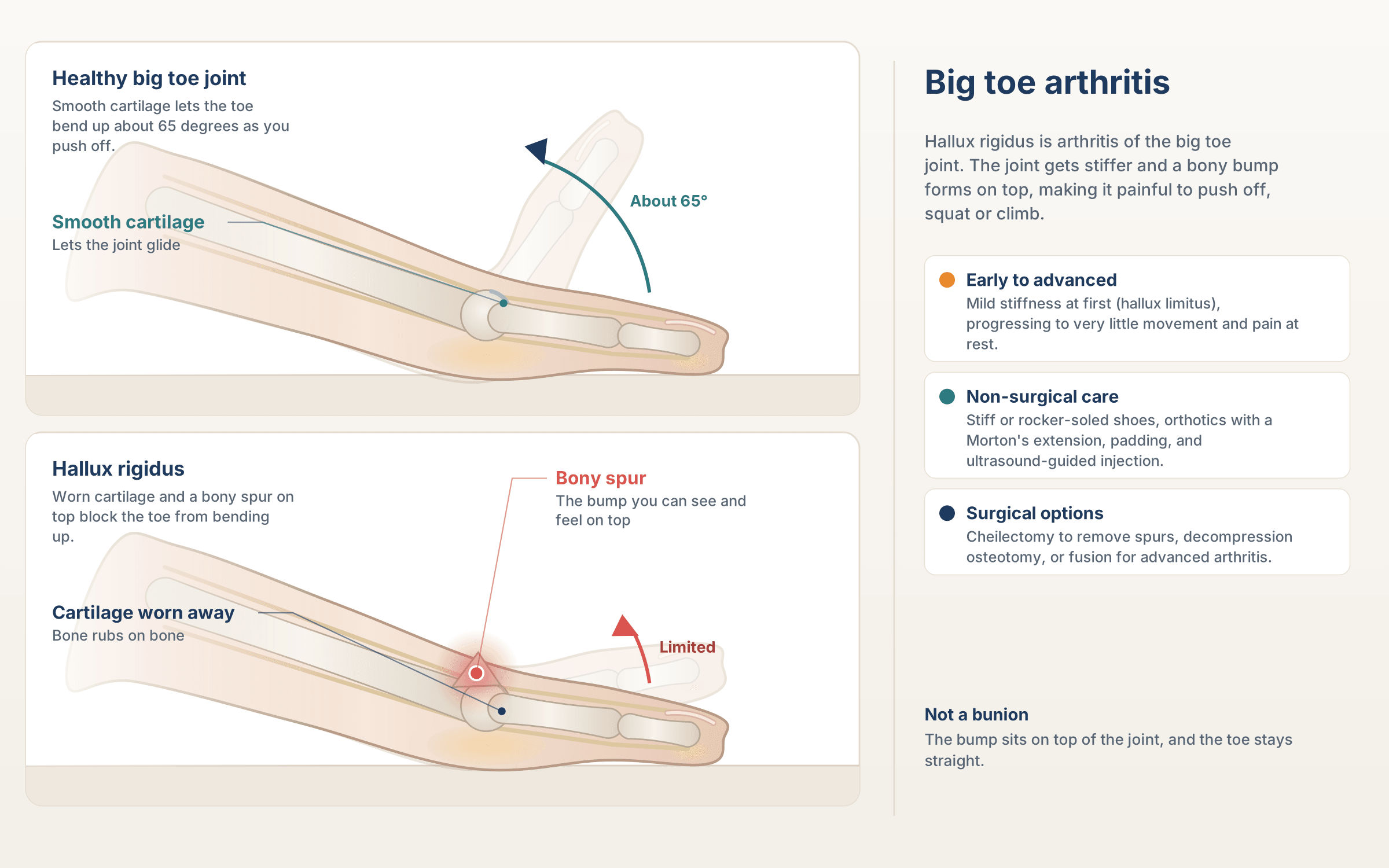
Hallux rigidus is wear and tear (osteoarthritis) of the joint at the base of the big toe, the first metatarsophalangeal (MTP) joint. As the smooth cartilage covering the joint wears down, the bones rub together, and the body forms bony spurs, especially on top of the joint. These spurs block the toe from bending upward, which is why the toe becomes stiff.
Stages of hallux rigidus
- Early (hallux limitus): mild stiffness and pain at the end of the toe’s movement, with a small spur
- Moderate: more stiffness, a larger bump on top of the joint, and pain with walking and pushing off
- Advanced: very little movement, significant cartilage loss and pain through the whole joint, sometimes even at rest
What causes hallux rigidus?
- Wear and tear with age: most common from middle age onward
- Injury: a previous stubbed toe, fracture or turf toe can damage the cartilage
- Foot structure: a long or elevated first metatarsal, or flat feet, which put extra strain on the joint
- Genetics: it often runs in families
- Repeated stress: sports and jobs that involve a lot of crouching, kneeling or pushing off
- Inflammatory conditions: such as gout and rheumatoid arthritis
Symptoms to look out for
- Pain and stiffness in the big toe joint, especially when walking, running or pushing off
- A bony bump on top of the joint that rubs on shoes
- Difficulty bending the big toe upward, such as when squatting or rising onto your toes
- Swelling and inflammation around the joint
- Pain that’s worse in cold, damp weather
- Walking on the outside of the foot to avoid the painful joint, causing pain elsewhere
- Numbness or tingling on top of the toe, from a nerve pressed by the spur
How is hallux rigidus diagnosed?
Your podiatrist will examine the big toe joint, measure how far it bends, feel for bony spurs and pinpoint the painful areas. We assess how you walk and the shoes you wear. Weight-bearing X-rays show the joint space, the size and position of the spurs and the stage of arthritis, which guides treatment.
Non-surgical treatment
- Footwear: shoes with a stiff sole or a rocker bottom, which reduce how much the big toe needs to bend, and a deep toe box to avoid pressure on the bump
- Custom orthotics, made from a 3D scan of your feet, often with a rigid extension under the big toe (a Morton’s extension) to limit painful movement
- Padding to protect the bump on top of the joint
- Activity changes, such as avoiding deep squats and steep hills
- Ultrasound-guided corticosteroid injection into the joint, provided by Dr Rohan Amir, to settle flare-ups of pain and inflammation
- Anti-inflammatory medication, in consultation with your GP or pharmacist
When is surgery needed?
Surgery is considered when pain and stiffness persist despite non-surgical care and interfere with daily life. Dr Ozan Amir, Surgical Podiatrist, will assess your joint and X-rays and discuss the options that suit the stage of your arthritis and your activity goals.
- Cheilectomy: removing the bony spurs on top of the joint to restore movement and relieve pain. Used for mild to moderate hallux rigidus, and keeps the joint.
- Decompression osteotomy: shortening and repositioning the first metatarsal to relieve pressure in the joint, which can be combined with a cheilectomy. An alternative to fusion in selected cases.
- First MTP joint fusion (arthrodesis): permanently joining the bones of the big toe joint in a slightly upward position, held with plates or screws. Used for advanced arthritis, it reliably relieves pain while allowing normal walking and most activities.
- Joint replacement or resurfacing: an option in selected cases, which Ozan can discuss.
Surgery is performed in a day surgery hospital. Recovery depends on the procedure, from a few weeks in a protective shoe after a cheilectomy to a longer period after a fusion. Ozan will explain the procedure, the recovery and the risks so you can make an informed decision.
Watch Dr Ozan Amir explain
Hallux Rigidus and the Cheilectomy Procedure
Cheilectomy for Stage II Hallux Rigidus
Hallux Rigidus: Comparing Clinical Presentation to Intra-operative Findings
An Alternative to Fusion of the Big Toe Joint: The Decompression Osteotomy
Metatarsus Primus Elevatus / Hallux Equinus / Hallux Rigidus (1st MTPJ Biomechanics)
First Metatarsophalangeal Joint Injuries – Splinting Using the Valguloc II Brace
Big Toe Arthritis (Hallux Rigidus) FAQs
No. A bunion is a change in the alignment of the big toe, with a bump on the side of the foot. Hallux rigidus is arthritis of the big toe joint, with stiffness and a bump on top of the joint. They can occur together.
Hallux rigidus often progresses slowly over time, although the rate varies. Good footwear and orthotics can help keep you comfortable.
Many people return to walking, hiking and some running after a fusion, although high heels and activities that need a lot of big toe movement can be limited. Ozan will talk through what to expect for your activities.
An injection can relieve a flare-up of pain and inflammation for a period, but it doesn’t reverse arthritis. It’s most useful alongside footwear and orthotic changes.
No, you can book directly. If your appointment is through a Medicare care plan, DVA or another funded program, you’ll need a referral, so check with us when you book.
Serving Manly and the Northern Beaches.
Manly Foot Clinic is at Shop 3/3 Corrie Rd, North Manly NSW 2100. We see patients from Manly, Balgowlah, Freshwater, Dee Why and Brookvale through to Mosman, Neutral Bay, Chatswood and the wider North Shore.