
What is an ingrown toenail?
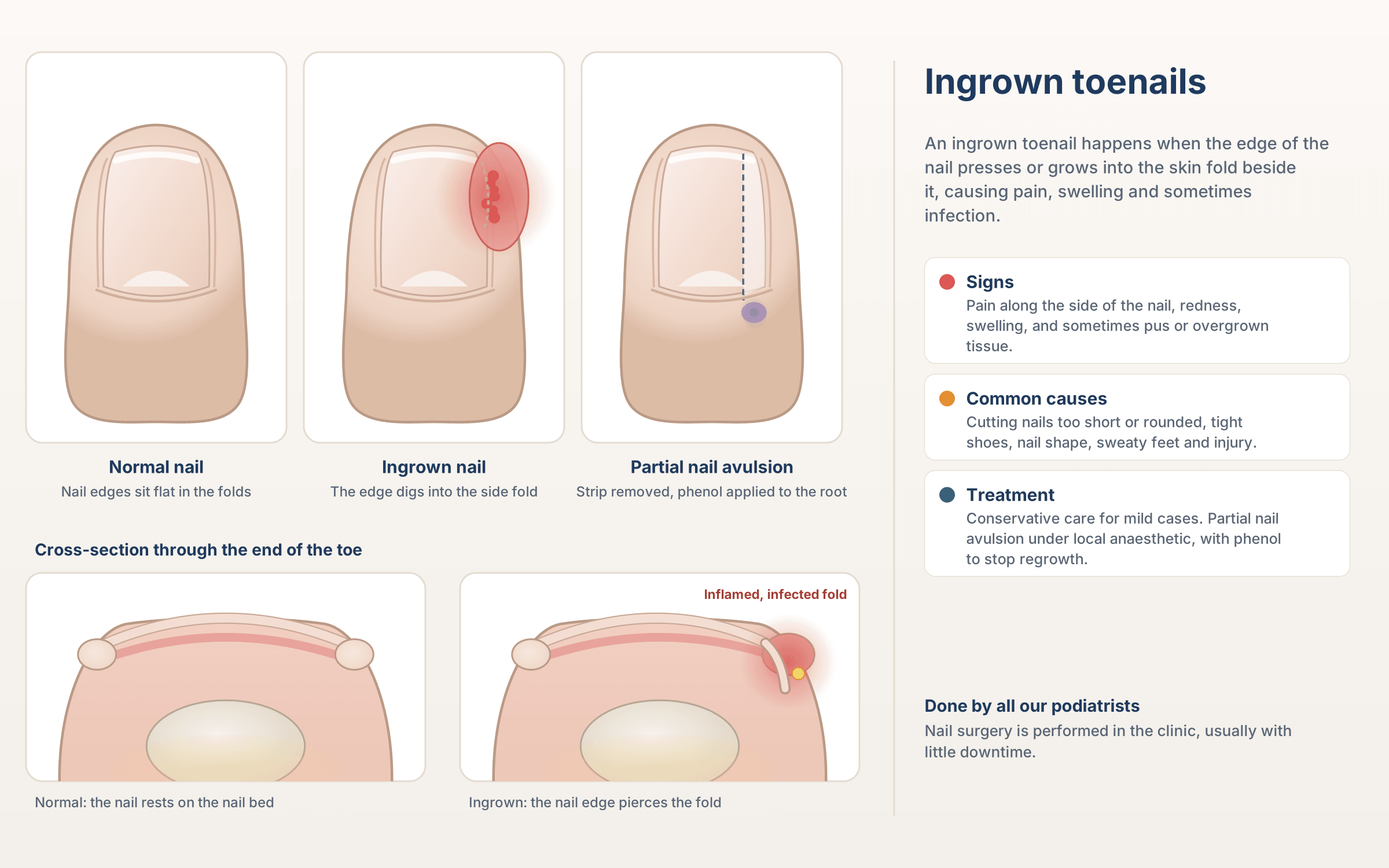
An ingrown toenail (onychocryptosis) happens when the edge of the nail grows or presses into the skin alongside it (the nail fold). The nail breaks the skin, which becomes inflamed, painful and often infected. Over time, the skin can overgrow the nail edge, forming swollen, red tissue that bleeds easily (hypergranulation tissue).
The big toe is most commonly affected, but any toenail can become ingrown.
Stages
- Stage 1: redness, mild swelling and pain along the nail edge
- Stage 2: increasing pain, swelling, drainage and infection
- Stage 3: overgrown, swollen tissue over the nail edge, with ongoing infection
What causes ingrown toenails?
- Cutting nails incorrectly: too short, or rounding off the corners, so the nail grows into the skin
- Nail shape: curved (pincer) or fan-shaped nails, which often run in families
- Tight or narrow shoes, and school or sports shoes that press on the toes
- Picking or tearing nails
- Injury, such as stubbing a toe or having it stood on
- Sweaty feet, especially in teenagers, which softens the skin
- Sports with lots of kicking or sudden stops, such as soccer, football and tennis
- Thickened or fungal nails
Symptoms to look out for
- Pain along one or both edges of the nail, often throbbing
- Redness and swelling of the skin beside the nail
- Pain with pressure from shoes, socks or bedsheets
- Discharge, pus or bleeding
- Swollen, red tissue growing over the nail edge
- An ingrown nail that keeps coming back
Seek prompt care if you have diabetes, poor circulation or reduced feeling in your feet, or if redness is spreading up the toe or foot, as these need urgent attention.
Conservative treatment
For a mildly ingrown nail, your podiatrist can often relieve the pain straight away by carefully trimming and removing the offending piece of nail (a spicule), cleaning the area and dressing it. We’ll show you how to cut your nails correctly and give you footwear advice. If the toe is infected, an oral antibiotic may be prescribed.
Nail surgery for recurring ingrown nails
If an ingrown toenail keeps coming back, or is severely infected, a minor surgical procedure can permanently fix the problem. All our podiatrists perform nail surgery here at the clinic, under local anaesthetic, with no hospital stay needed. Instruments are sterilised on site and aseptic technique is used throughout.
Partial nail avulsion (PNA) with phenolisation The most common procedure. After numbing the toe with a local anaesthetic, a narrow strip of nail is removed from the problem edge, right back to the root. A chemical called phenol is then applied to the nail root (matrix) at that edge, so the strip doesn’t grow back. The nail is left slightly narrower, and looks natural once healed.
Winograd procedure (wedge resection) For nails with significant overgrown tissue, the problem nail edge, the nail root at that edge and the overgrown skin are removed surgically, and the wound is stitched. This gives a neat result where the nail fold is very enlarged.
Total nail avulsion In some cases, such as a badly damaged, thickened or fungal nail, the whole nail is removed, with or without treating the root to stop it regrowing.
What to expect
The procedure takes about an hour, including the anaesthetic. A light dressing is applied, and we recommend bringing open-toed shoes or sandals to wear home. Most people have very little pain afterwards and can return to normal activity the next day, avoiding sport and swimming for a short period. We’ll show you how to dress the toe and see you for follow-up visits to check healing, which usually takes two to four weeks after a partial nail avulsion with phenol.
Phenol greatly reduces the chance of the nail edge growing back, but a small number of nails do regrow, and can be retreated if needed.
Ingrown toenails in children and teenagers
Ingrown toenails are very common in teenagers, often due to sweaty feet, growth spurts, sport and nail cutting habits. The assessment and procedures are the same as for adults, and we pace the appointment to make sure young patients feel comfortable.
Watch Dr Ozan Amir explain
Ingrown Toenail Procedures: Winograd Technique & Partial Nail Avulsion with Phenolisation
Partial Nail Avulsion Procedure for Ingrown Toenails
Ingrown Toenail Surgery: Bilateral Hallux Partial Nail Avulsion Technique
Performing a Wedge Resection for Ingrown Nails
Total Nail Avulsion for Ingrown Nails
Nail Regrowth After Nail Surgery
Continued Pain After a Partial Nail Avulsion? Could Be a Result of Phenol Burn
Treating Inflammation and Infection of the Proximal Nail Fold
Persistent Paronychia Even After 5 Courses of Antibiotics
Ingrown Toenails FAQs
The local anaesthetic injection stings briefly, then the toe goes numb, so you shouldn’t feel pain during the procedure. Afterwards, most people have only mild discomfort.
After a partial nail avulsion with phenol, the treated edge usually doesn’t grow back. A small number do regrow and can be retreated.
Not always. Removing the piece of nail that’s causing the problem is the main treatment. Antibiotics are used when there’s significant infection.
Cut straight across, not too short, and avoid rounding off the corners or digging down the sides.
Usually within one to two weeks, once the toe is comfortable and healing well. We’ll guide you at your follow-up.
No, you can book directly. If your appointment is through a Medicare care plan, DVA or another funded program, you’ll need a referral, so check with us when you book.
Serving Manly and the Northern Beaches.
Manly Foot Clinic is at Shop 3/3 Corrie Rd, North Manly NSW 2100. We see patients from Manly, Balgowlah, Freshwater, Dee Why and Brookvale through to Mosman, Neutral Bay, Chatswood and the wider North Shore.