What is a fungal nail infection?
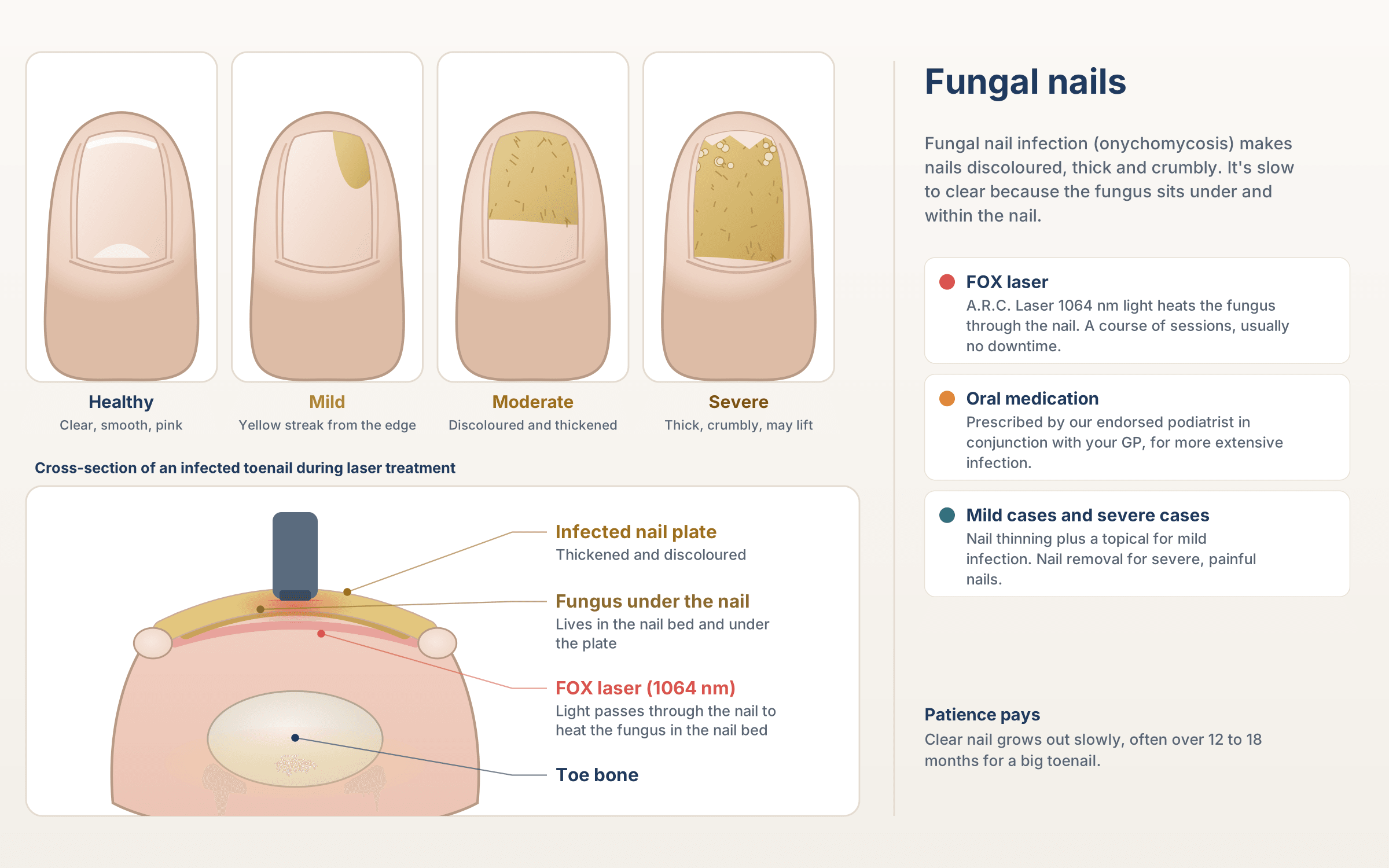
A fungal nail infection happens when fungi, usually a type called dermatophytes, get under the nail and feed on keratin, the protein the nail is made of. These fungi thrive in warm, dark, damp places, which is why enclosed shoes, sweaty socks and shared showers are common sources. The infection often starts at the tip or edge of the nail and spreads slowly toward the base, and can pass from one nail to others.
Signs of a fungal nail
- Yellow, white or brown discolouration
- Thickening that makes the nail hard to cut
- Brittle, crumbly or ragged edges
- The nail lifting away from the skin underneath
- Debris building up under the nail
- In some cases, discomfort in shoes or an unpleasant smell
Getting the diagnosis right first
Not every thick or discoloured nail is fungal. Damage from shoes or sport, psoriasis and other skin conditions can look very similar. Because toenails grow slowly, treating the wrong problem can waste months. Your podiatrist will examine your nails and confirm a fungal infection before recommending treatment.
Treatment matched to severity
Mild infections. When only part of the nail is affected, thinning the nail down in the clinic, followed by a topical antifungal applied at home, may be enough to clear the infection.
Moderate infections. The FOX laser, often combined with nail thinning and a topical antifungal, is our main treatment.
Severe or stubborn infections. Where the whole nail is affected, or other treatments haven’t worked, we may recommend oral antifungal medication, nail removal, or a combination of treatments.
The FOX laser
The FOX is a medical diode laser made by A.R.C. Laser in Germany. It works at a wavelength of 1064 nanometres, which passes through the nail plate to reach the infected nail bed underneath, where the fungus lives.
How FOX laser treatment works
The laser delivers controlled pulses of energy that gently heat the nail and nail bed. The fungus is more sensitive to heat than the surrounding healthy tissue, so the treatment targets the infection while leaving your skin unharmed. The laser is passed over each affected nail in a set pattern, so the whole nail and the surrounding skin, where fungus can also hide, are treated.
Why choose laser treatment?
- No medication needed. Laser is a good option for people who can’t, or would rather not, take oral antifungal tablets.
- No anaesthetic, no downtime. Most people describe a feeling of warmth during treatment. You can walk out and go straight back to your normal day.
- Reaches where creams can’t. Topical treatments struggle to get through a thick nail. The laser’s wavelength passes through the nail to the infection underneath.
- Quick appointments. A session usually takes around [30] minutes, depending on how many nails are treated.
What to expect at your laser appointment
- Preparation. Your podiatrist trims and thins the affected nails, so the laser reaches the infection more effectively. Please remove any nail polish before you come.
- Treatment. You and your podiatrist wear protective glasses. The laser is passed over each affected nail and the skin around it. If the warmth becomes too much, the podiatrist pauses and adjusts.
- Afterwards. No dressings are needed, and you can wear your normal shoes straight away. You’ll be given advice on footwear, sock hygiene and an antifungal to use at home to reduce the chance of reinfection.
How many sessions will I need?
Most people have a course of [number] sessions, spaced [interval] apart. The exact plan depends on how many nails are affected and how severe the infection is, and your podiatrist will explain it at your assessment.
When will I see results?
The laser treats the infection, but the damaged part of the nail doesn’t change colour. It has to grow out. The sign that treatment is working is clear, healthy nail growing up from the base. Fingernails take around six months to grow out fully, and a big toenail can take 12 to 18 months, so patience is part of the process. We’ll review your progress and take photos at follow-up visits so you can see the change over time.
Is laser treatment right for me?
Laser treatment suits most people with fungal nails. Let us know if you’re pregnant, have reduced feeling in your feet, have poor circulation, or take medication that makes your skin sensitive to light. In those cases, your podiatrist will discuss whether laser is suitable or whether another option would be better.
Nail thinning and topical antifungals
Thick fungal nails are painful in shoes and hard for medication to get through. Your podiatrist reduces the thickness of the nail in the clinic, which relieves pressure and lets topical antifungal paints or solutions reach the infection. For mild infections, this combination alone may clear the nail.
Oral antifungal medication
For more widespread or stubborn infections, tablets can treat the fungus from the inside as the new nail grows. Our podiatrist endorsed for scheduled medicines can prescribe oral antifungals, working in conjunction with your GP. Before starting, we’ll check your medical history and current medications, and arrange any blood tests your GP recommends.
Nail removal
In severe cases, or when other treatments haven’t worked, the infected nail can be removed. This is a minor procedure done here in the clinic under local anaesthetic, with no hospital stay. Removing the nail gets rid of the bulk of the infection, relieves pain and pressure, and lets the nail bed be treated directly while a new nail grows. Where a nail is repeatedly infected, painful or badly deformed, the nail can be removed permanently. Your podiatrist will talk you through the options, recovery and aftercare before anything is booked.
Preventing reinfection
Whatever treatment you have, we’ll help you treat any athlete’s foot and deal with fungal spores in your shoes and socks, so the infection is less likely to come back.
Preventing fungal nails coming back
- Keep feet clean and dry, especially between the toes
- Change socks daily, and choose moisture-wicking fabrics
- Rotate your shoes so each pair dries out between wears
- Wear thongs in shared showers and at the pool
- Treat athlete’s foot promptly
- Don’t share nail clippers or files
Watch Dr Ozan Amir explain
I Struggled Removing This Thickened Nail!
Total Nail Avulsion for Ingrown Nails
Nail Regrowth After Nail Surgery
Fungal Nails FAQs
Most people feel only warmth during treatment. If it becomes uncomfortable, your podiatrist pauses or adjusts the settings. No anaesthetic is needed.
Usually around [30] minutes, depending on how many nails are being treated.
Yes. Our podiatrist endorsed for scheduled medicines can prescribe oral antifungals, working in conjunction with your GP.
Most fungal nails don’t need removing. Nail removal is reserved for severe infections, or nails that haven’t responded to other treatment. It’s done in the clinic under local anaesthetic.
Please remove polish before each laser session. Ask your podiatrist when it’s fine to wear it again.
No. The damaged part of the nail has to grow out, which takes months. You’ll see healthy nail gradually growing from the base.
Yes. Fungal infections can return, especially if shoes and socks carry fungal spores. Following the prevention advice and treating athlete’s foot reduces the risk.
[Laser treatment is $X per session / $X for a course.] Costs are confirmed at your assessment. Laser isn’t usually covered by private health insurance, but your consultation is covered under the podiatry part of your extras cover.
No, you can book directly. If your appointment is through a Medicare care plan, DVA or another funded program, you’ll need a referral, so check with us when you book.
Serving Manly and the Northern Beaches.
Manly Foot Clinic is at Shop 3/3 Corrie Rd, North Manly NSW 2100. We see patients from Manly, Balgowlah, Freshwater, Dee Why and Brookvale through to Mosman, Neutral Bay, Chatswood and the wider North Shore.