
What is metatarsalgia?
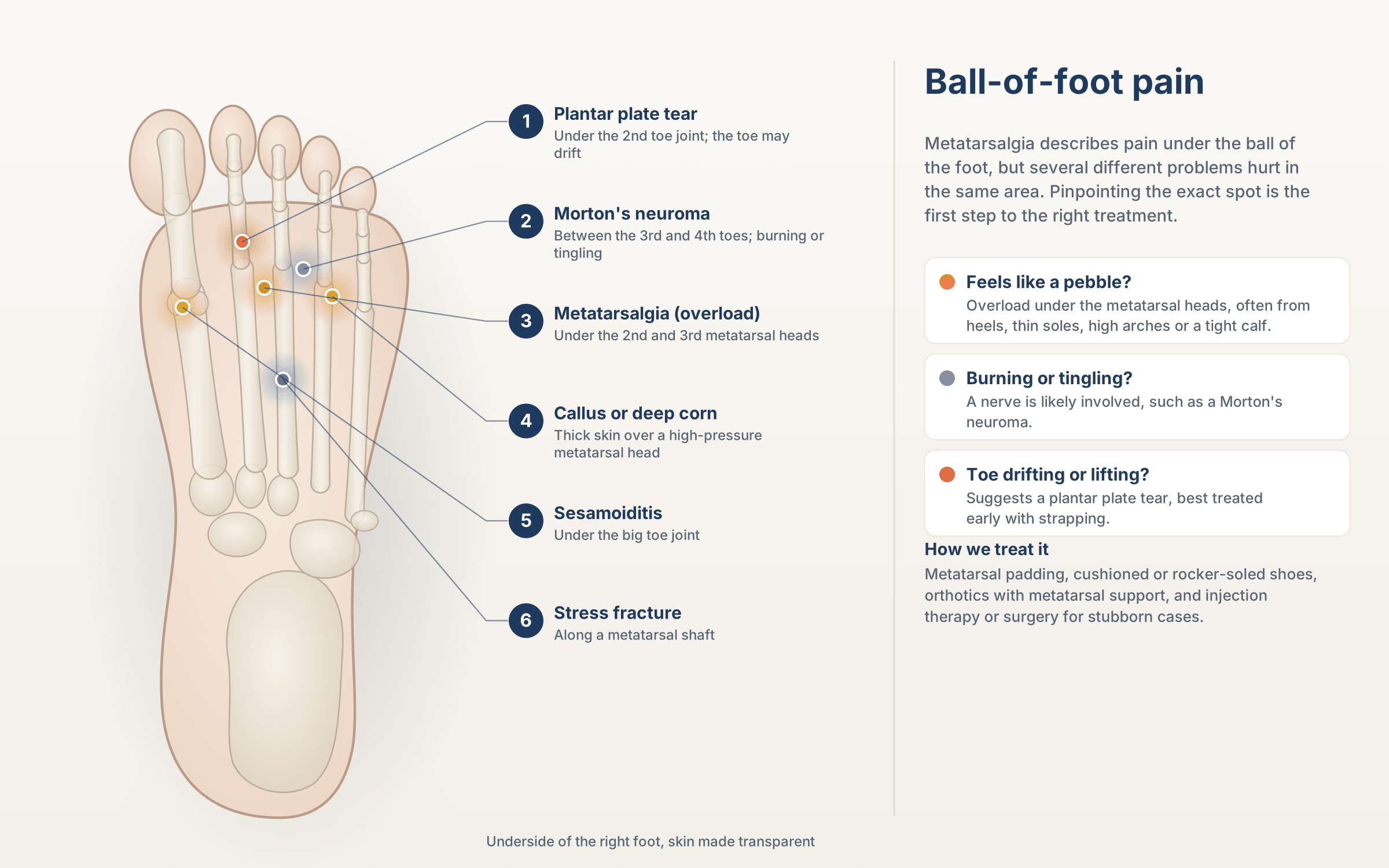
The ball of the foot sits over the heads of the five long bones in the forefoot (the metatarsals), just behind the toes. With every step, and especially when you push off, these metatarsal heads take a large share of your body weight. When the load is too great or poorly spread, the bones, joints and soft tissues under them become painful.
Common causes of ball-of-foot pain
- Metatarsalgia (overload): pain under one or more metatarsal heads, most often the second and third
- Plantar plate tear: a torn ligament under the toe joint, usually the second toe, often with the toe drifting or lifting
- Morton’s neuroma: a thickened nerve between the toes, causing burning, tingling or numbness
- Sesamoiditis: pain under the big toe joint
- Stress fracture: a crack in a metatarsal bone from repetitive loading
- Callus or corn: thickened skin from pressure, which can be painful in its own right
- Arthritis or synovitis of the toe joints, including gout and inflammatory arthritis
- Freiberg’s disease: a rare condition affecting the metatarsal head in teenagers
What causes metatarsalgia?
- Footwear: high heels, which shift weight forward, and thin-soled or narrow shoes
- High-impact activity: running and jumping sports
- Foot shape: high arches, a long second metatarsal, or a tight calf that pushes load onto the forefoot
- Toe deformities: bunions and hammer toes change how load is spread
- Thinning of the forefoot fat pad, which happens naturally with age
- Body weight and long hours standing on hard floors
- Arthritis and other joint conditions
Symptoms to look out for
- Sharp, aching or burning pain under the ball of the foot
- A feeling of walking on a pebble or a bunched-up sock
- Pain that’s worse when standing, walking barefoot on hard floors, running or wearing heels
- Pain that eases with rest
- Tingling or numbness in the toes (which suggests a nerve is involved)
- Callus under the ball of the foot
- A toe that’s drifting sideways or lifting up (which suggests a plantar plate tear)
How is metatarsalgia diagnosed?
Your podiatrist will ask about your symptoms, footwear and activity, then examine the forefoot, pressing each metatarsal head and toe joint to find exactly where it hurts. We test the stability of the toe joints to check for a plantar plate tear, squeeze the forefoot to check for a neuroma, and assess your foot structure, calf flexibility and how you walk. Where it would help, we arrange an ultrasound, X-ray or MRI to confirm the diagnosis and rule out a stress fracture.
Offload the painful area
- Metatarsal padding, placed just behind the painful area to spread the load
- Footwear changes: cushioned shoes with a wide toe box and a rocker sole, and a break from high heels and thin soles
- Callus removal, which can give instant relief when thick skin is adding pressure
- Strapping, especially for plantar plate tears
Correct the cause
- Custom orthotics, made from a 3D scan of your feet, with metatarsal support built in to take pressure off the painful area
- Calf stretching and foot strengthening, to reduce load on the forefoot
- Activity changes, such as reducing high-impact training while it settles
For pain that won’t settle
- Ultrasound-guided injection therapy. Where inflammation in a toe joint, bursa or around a nerve is contributing, Dr Rohan Amir can place an injection precisely under ultrasound guidance.
- Shockwave therapy for some long-standing soft tissue problems, usually over a course of 3 to 5 weekly sessions.
- Surgical opinion. If pain continues despite thorough treatment, Dr Ozan Amir, Surgical Podiatrist, can assess whether surgery is an option, such as repairing a plantar plate, correcting a toe deformity, removing a neuroma, or a metatarsal osteotomy to rebalance the load across the forefoot.
How long does metatarsalgia take to settle?
With the right padding, footwear and orthotics, many people notice a big improvement within a few weeks. Treating the underlying cause, rather than just the pain, is what stops it coming back.
Watch Dr Ozan Amir explain
Which Is It? Neuroma or Plantar Plate Pathology
This Is What the Plantar Plate Looks Like
Intractable Plantar Keratosis (IPK) and Its Association with Smoking
Metatarsalgia (Ball-of-Foot Pain) FAQs
No. Metatarsalgia describes pain under the ball of the foot from overload. A Morton’s neuroma is a thickened nerve between the toes, which often causes burning, tingling or numbness. They can feel similar, so an accurate diagnosis matters.
Usually, yes. Orthotics with metatarsal support can take pressure off the painful area and spread the load more evenly across the forefoot.
High heels push more of your weight onto the ball of the foot. While it settles, a lower heel and a cushioned, wide shoe will help. Afterwards, limiting how often and how long you wear heels reduces the chance of it returning.
Pain under the second toe is a common sign of metatarsalgia or a plantar plate tear, especially if the toe is starting to drift or lift. It’s worth having it assessed early, before the toe deformity progresses.
No, you can book directly. If your appointment is through a Medicare care plan, DVA or another funded program, you’ll need a referral, so check with us when you book.
Serving Manly and the Northern Beaches.
Manly Foot Clinic is at Shop 3/3 Corrie Rd, North Manly NSW 2100. We see patients from Manly, Balgowlah, Freshwater, Dee Why and Brookvale through to Mosman, Neutral Bay, Chatswood and the wider North Shore.