
What are shin splints?
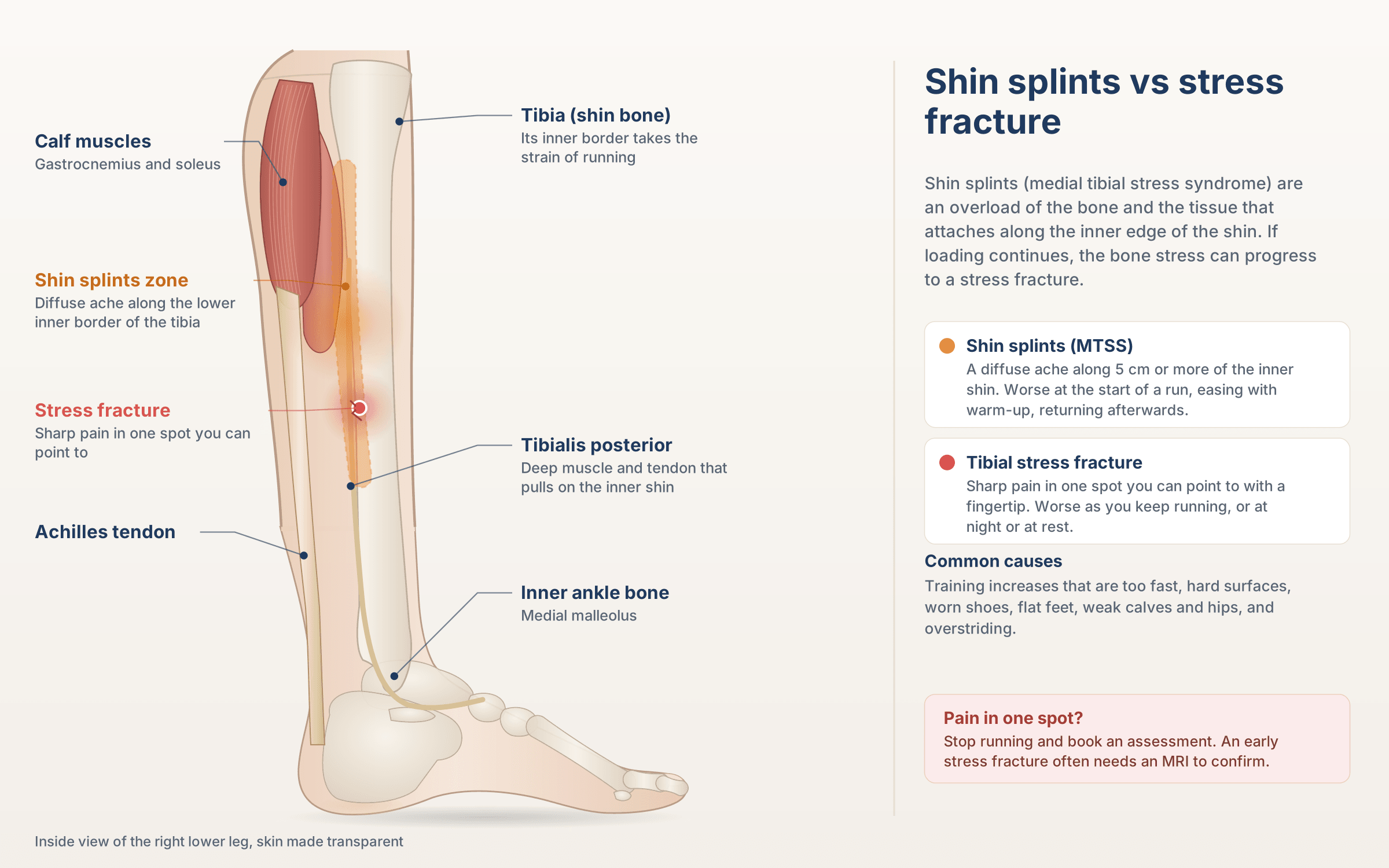
"Shin splints" is the everyday name for medial tibial stress syndrome (MTSS): pain along the inner edge of the shin bone (tibia), usually in the lower two-thirds of the leg. It happens when the bone and the tissue that attaches to it are loaded faster than they can adapt.
Shin splints sit at the mild end of a range of bone stress injuries. If the overload continues, it can progress to a tibial stress fracture, which needs a longer period of offloading. Telling the two apart early is one of the most important parts of your assessment.
Shin splints or stress fracture?
- Shin splints: a diffuse ache along 5 cm or more of the inner shin, usually worse at the start of a run, easing as you warm up, then returning afterwards.
- Stress fracture: sharp pain in one spot you can point to with a fingertip, pain that gets worse as you keep running, or pain at night or at rest.
If your pain fits the second description, stop running and book an assessment rather than pushing through.
What causes shin splints?
Shin splints usually follow a change in load that the leg hasn’t had time to adapt to:
- Training errors. Increasing distance, frequency or speed too quickly, or adding hills and speed work all at once.
- Returning to sport at the level you stopped at, rather than building back up.
- Hard surfaces. Moving from grass or trails to concrete or roads.
- Footwear. Worn-out, unsuitable or brand-new shoes without a gradual changeover.
- Foot mechanics. Flat feet or feet that roll in excessively increase the strain on the inner shin.
- Calf and hip weakness. A weak soleus (the deep calf muscle) and weak hips leave the shin bone absorbing more load.
- Running technique. Overstriding and a low step rate increase impact forces.
- Bone health. Low energy intake, low vitamin D, and in women, irregular periods, can reduce bone strength and increase the risk.
Symptoms to look out for
- Aching or sharp pain along the inner edge of the shin
- Tenderness over several centimetres of the bone
- Pain at the start of a run that eases with warm-up, then returns afterwards or the next morning
- Pain that starts earlier in each run and lasts longer as the problem worsens
- Mild swelling along the lower inner shin
How are shin splints diagnosed?
Shin splints are diagnosed from your training history and an examination. Your podiatrist feels along the shin to map exactly where it’s tender, assesses calf strength and ankle flexibility, examines your foot posture, and watches you walk and run. Video gait analysis can show overstriding, excessive pronation or other patterns that overload the shin. If a stress fracture is suspected, we arrange imaging, usually an MRI, because early stress fractures often don’t show on X-ray.
Stage 1: settle the shin
- Reduce, don’t necessarily stop. We cut your running back to a level that doesn’t provoke pain, or swap it for cycling, swimming or deep-water running for a while to keep your fitness.
- Footwear review. Checking your shoes are suited to your feet and your running, and replacing worn pairs.
- Strapping or compression for short-term comfort.
Stage 2: fix the cause
- Strengthening. A progressive program for the calf (especially the soleus), foot and hip muscles, so the leg handles load better.
- Gait retraining. Small changes, such as a slightly higher step rate and a shorter stride, can significantly reduce the load on the shin.
- Custom orthotics, made from a 3D scan of your feet, where foot mechanics are adding strain.
- Training plan. Reviewing surfaces, weekly volume and recovery days.
Stage 3: return to running
Once you can walk briskly and hop on the affected leg without pain, we build a return-to-running plan in clear steps:
- Walk-run intervals on flat, forgiving surfaces, every second day
- Gradually increasing the running time, then reducing the walk breaks
- Continuous easy running
- Slowly adding distance, then hills and speed work, one at a time
As a guide, mild discomfort (around 3 out of 10 or less) that settles by the next day is acceptable. Pain that’s sharper, lasts longer or builds during a run means it’s time to step back a stage.
Stage 4: for pain that won’t settle
If pain persists despite a well-managed program, we reassess the diagnosis, as other conditions can cause shin pain. Shockwave therapy may be an option for long-standing shin splints, usually over a course of 3 to 5 weekly sessions.
How long do shin splints take to get better?
Mild shin splints often settle within a few weeks of reducing load and starting the right exercises. More established cases can take two to three months to return to full training. A stress fracture usually takes longer, often six to eight weeks or more before running resumes. The biggest factor is building back up gradually rather than returning to full training as soon as the pain eases.
Shin pain in children and teenagers
Growing athletes are especially prone to shin pain at the start of a new season, when training load jumps suddenly. Because their bones are still developing, we have a low threshold for assessing shin pain in children and teenagers. We look at growth, training load and footwear together, and work with parents and coaches on a sensible return to sport.
Other causes of lower leg pain
Not every painful shin is shin splints. Your podiatrist will also check for:
- Tibial stress fracture: focal bone pain, often worse at night or rest
- Chronic exertional compartment syndrome: tightness, cramping or numbness that builds during exercise and eases soon after stopping
- Tibialis posterior tendinopathy: pain behind the inner ankle that can extend up the shin
- Calf muscle strain: sudden pain in the back of the lower leg
Shin Splints FAQs
Often, yes, at a reduced load, as long as the pain stays mild and settles by the next day. If the pain is in one spot, gets worse as you run, or is there at night or at rest, stop running and have it assessed, as it may be a stress fracture.
Shin splints usually cause a spread-out ache along the inner shin. A stress fracture is more often sharp pain in one small spot, which can be worse at night. We arrange an MRI if a stress fracture is suspected.
They can, when your foot mechanics are contributing. Orthotics work best alongside strengthening, the right footwear and a sensible training plan.
Possibly. Worn-out or unsuitable shoes can contribute, but there’s no single best shoe. We’ll look at your feet, your running and your current shoes and advise you.
Often a few weeks for mild cases, and two to three months to return to full training for more established ones.
No, you can book directly. If your appointment is through a Medicare care plan, DVA or another funded program, you’ll need a referral, so check with us when you book.
Serving Manly and the Northern Beaches.
Manly Foot Clinic is at Shop 3/3 Corrie Rd, North Manly NSW 2100. We see patients from Manly, Balgowlah, Freshwater, Dee Why and Brookvale through to Mosman, Neutral Bay, Chatswood and the wider North Shore.