What is a bunion?
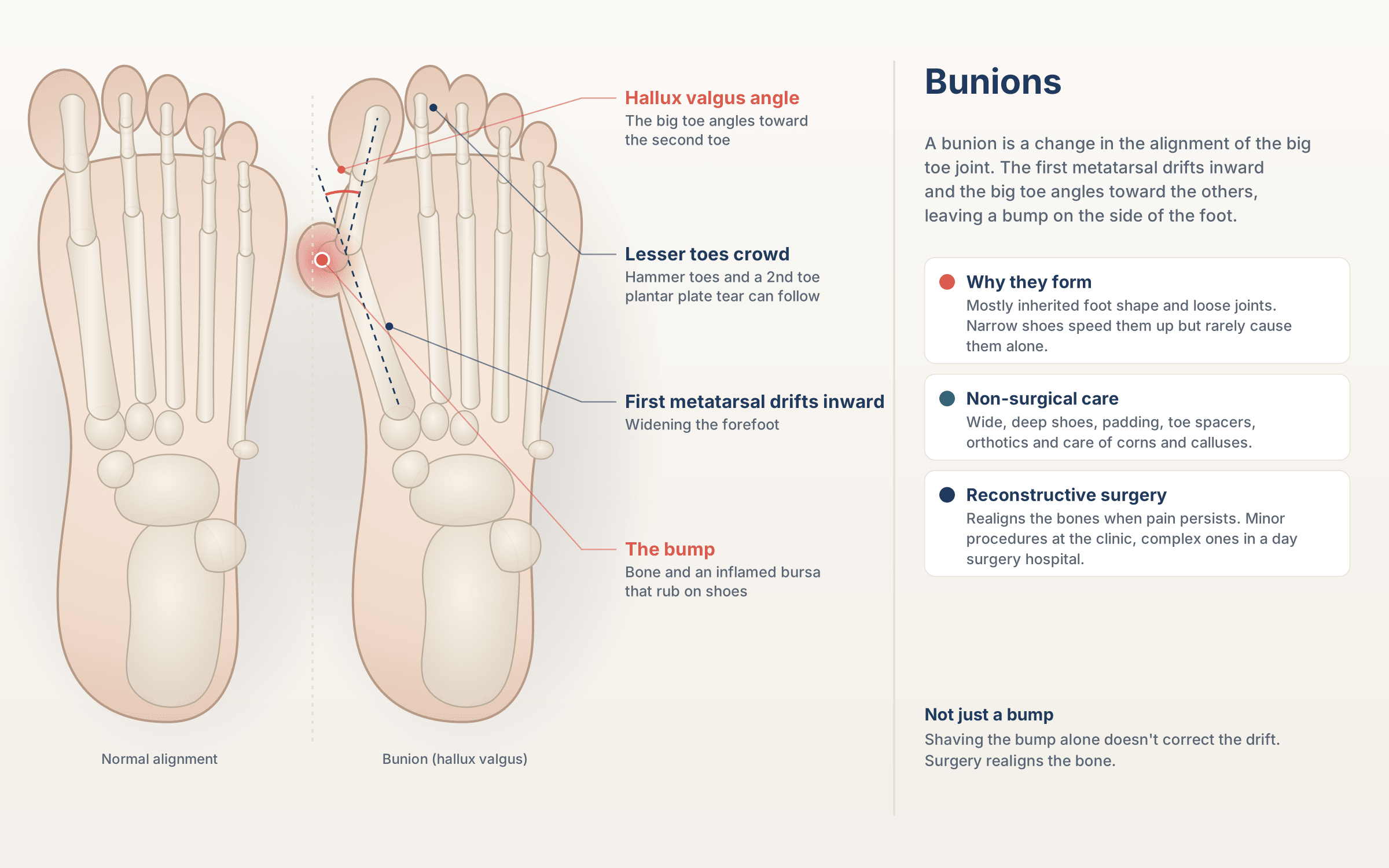
A bunion (hallux valgus) forms when the first metatarsal bone drifts towards the middle of the body, while the big toe leans towards the second toe. The head of the metatarsal then pushes out on the side of the foot, creating the bump. The bump isn’t new bone growth. It’s mostly the joint itself, sticking out because the bones are out of line.
As a bunion progresses, the big toe joint can become stiff and arthritic, the big toe can push under or over the second toe, and the ball of the foot can take extra load, leading to pain under the smaller toes.
Tailor’s bunion (bunionette)
A tailor’s bunion is a similar bump on the outside of the foot, at the base of the little toe. It’s treated in a similar way.
What causes bunions?
- Genetics: bunions run strongly in families, because foot shape and joint laxity are inherited
- Foot mechanics: flat feet, feet that roll in, and a loose first metatarsal joint
- Footwear: narrow, pointed shoes and high heels don’t cause bunions on their own, but they can speed up progression and make them painful
- Inflammatory arthritis, such as rheumatoid arthritis
- Joint hypermobility
- Injury to the big toe joint
Bunions are more common in women, and often start in the teens or twenties.
Symptoms to look out for
- A bump on the inside of the foot at the base of the big toe
- Pain, redness or swelling over the bump, especially in shoes
- A big toe that angles towards, under or over the second toe
- Stiffness or pain in the big toe joint
- Pain under the ball of the foot (metatarsalgia)
- Corns or calluses between the toes or under the foot
- A second toe that’s starting to drift or curl (hammer toe or plantar plate tear)
- Difficulty finding shoes that fit
How are bunions diagnosed?
Your podiatrist will examine the foot standing and sitting, check the movement and alignment of the big toe joint, look at how you walk, and assess your footwear. Weight-bearing X-rays measure the angles between the bones (the hallux valgus and intermetatarsal angles), assess the joint for arthritis, and are essential for planning surgery.
Non-surgical treatment
Non-surgical care can’t straighten a bunion, but it can relieve pain, protect the joint and slow progression.
- Footwear: shoes with a wide, deep toe box, soft uppers and a low heel
- Padding and toe spacers to protect the bump and reduce rubbing between the toes
- Custom orthotics, made from a 3D scan of your feet, to improve foot function and reduce load on the big toe joint
- Corn and callus care, to relieve pressure areas
- Exercises to maintain big toe joint movement and strengthen the foot
- Shoe stretching over the bump
- Ultrasound-guided injection, for an inflamed bursa over the bump or a painful joint
When is bunion surgery needed?
Surgery is considered when a bunion is painful despite non-surgical care, interferes with daily activities, or is causing other problems such as a drifting second toe or ball-of-foot pain. Surgery isn’t recommended just for appearance.
Dr Ozan Amir, Surgical Podiatrist, will assess your foot and X-rays and recommend the procedure, or combination of procedures, that best suits your bunion. The choice depends on the severity of the deformity, the health of the joint, your age and activity level.
Types of bunion surgery
- Distal osteotomy (such as the Chevron or Austin bunionectomy): the end of the first metatarsal is cut and shifted into a better position, then held with a small screw or pin. Used for mild to moderate bunions.
- Akin osteotomy: a small correction of the big toe bone, often combined with other procedures to fully straighten the toe.
- Proximal or shaft osteotomies (such as the Scarf): for larger bunions, the metatarsal is corrected further back, along its length.
- Lapidus procedure: fusion of the joint at the base of the first metatarsal, for severe bunions or a very mobile first metatarsal.
- First MTP joint fusion: for bunions with significant arthritis in the big toe joint.
- Tailor’s bunion correction: a similar osteotomy of the fifth metatarsal.
Lesser toe problems, such as hammer toes or a plantar plate tear, are often corrected at the same time.
What to expect
Bunion surgery is performed in a day surgery hospital, usually under general anaesthetic or local anaesthetic with sedation, and most people go home the same day. Afterwards, you’ll usually walk in a protective post-operative shoe for a few weeks, with swelling settling gradually over the following months. Ozan will give you a recovery timeline specific to your procedure, and explain the risks, before anything is booked.
Bunions in children and teenagers
Bunions can start in childhood (juvenile hallux valgus). In growing children, we focus on footwear, orthotics and monitoring, and surgery is usually delayed until the growth plates have closed. Gentle taping can help comfort in younger children.
Watch Dr Ozan Amir explain
The Chevron Bunionectomy for Correcting Hallux Valgus (Bunion) Deformity
Demonstrating the Chevron & Akin Osteotomies Under Fluoroscopy
'Lock Pin' Technique for Fixating the Chevron/Austin Bunionectomy
Correcting a Bunion – Chevron Style Bunionectomy
Tailor’s Bunion Surgical Correction
Bunion Pain? Consider Compression of the Proper Dorsal Cutaneous Nerve
What Happens 3 Weeks After Bunion Surgery
How to Tape After Bunion Surgery
A Simple Technique for Taping Children with Bunions
Bunions FAQs
Bunions usually progress slowly over time, although the rate varies. Good footwear and orthotics can help slow progression and keep you comfortable.
Non-surgical treatment can relieve pain and slow progression, but only surgery can realign the bones and correct the bunion.
It depends on the procedure. Most people walk in a protective shoe for a few weeks, then gradually return to normal shoes, with swelling settling over several months. Ozan will give you a timeline for your specific procedure.
Recurrence can happen, but choosing the right procedure for your bunion, and addressing the underlying foot mechanics, reduces the risk. Ozan will discuss this with you.
They can relieve rubbing and discomfort, but they don’t permanently realign the bones.
Your consultation is covered under the podiatry part of your extras cover. For surgery, check with your fund what’s covered for podiatric surgery, including the surgeon’s fee and the hospital and anaesthetist fees.
No, you can book directly. If your appointment is through a Medicare care plan, DVA or another funded program, you’ll need a referral, so check with us when you book.
Serving Manly and the Northern Beaches.
Manly Foot Clinic is at Shop 3/3 Corrie Rd, North Manly NSW 2100. We see patients from Manly, Balgowlah, Freshwater, Dee Why and Brookvale through to Mosman, Neutral Bay, Chatswood and the wider North Shore.