What is plantar fasciitis?
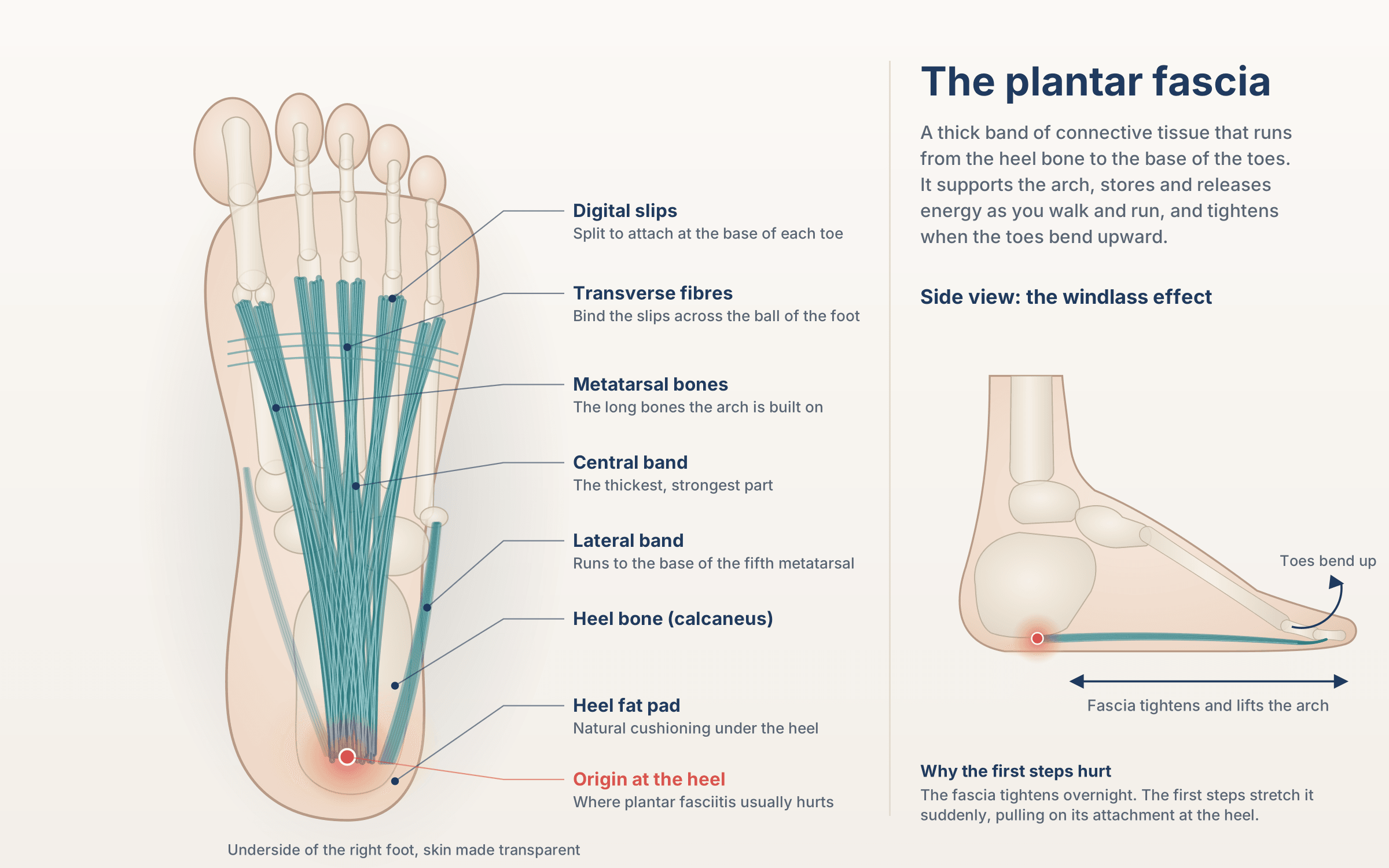
The plantar fascia is a thick, strong band of tissue that runs along the sole of the foot, from the heel bone to the base of the toes. It supports the arch and acts like a spring, absorbing load every time your foot hits the ground.
Plantar fasciitis develops when the fascia is overloaded where it attaches to the heel. Small amounts of damage build up faster than the tissue can repair them, and the area becomes painful.
Fasciitis or fasciosis?
"Itis" means inflammation, and in the early stages there can be some. In longer-standing cases, though, the tissue is usually thickened and degenerated rather than inflamed, which is why some clinicians call it plantar fasciosis. The difference matters: anti-inflammatory tablets alone often don’t fix it, while treatments that reduce load and stimulate healing, such as strengthening, orthotics and shockwave, tend to work better.
Why it hurts most in the morning
While you sleep or sit, the plantar fascia tightens and starts to heal in a shortened position. Your first steps stretch it suddenly, which is why those steps are so painful. As you keep walking, the tissue loosens and the pain eases, until a long rest or a long day on your feet sets it off again.
What causes plantar fasciitis?
There’s rarely a single cause. It usually comes from a combination of:
- A change in load. Starting a new sport, running further, a new job on your feet, or a big increase in walking.
- Tight calves. A tight calf and Achilles tendon increase the pull on the plantar fascia with every step.
- Foot structure. Flat feet stretch the fascia, while high arches reduce shock absorption.
- Footwear. Thongs, worn-out runners, and flat, unsupportive shoes, especially on hard floors.
- Weak foot and calf muscles. These leave the fascia to take more of the load.
- Body weight. Extra weight increases the load through the heel.
- Age. It’s most common between about 40 and 60.
Symptoms
- Sharp or stabbing pain under the heel, usually on the inside
- Pain worst with the first steps in the morning or after sitting
- Pain that eases after a few minutes of walking, then returns later in the day
- Pain after, rather than during, exercise
- Tenderness when you press on the underside of the heel
- Symptoms that gradually build over weeks or months
If your pain burns, tingles or shoots, or is worse at night, a nerve may be involved instead, so see us for an assessment.
How is plantar fasciitis diagnosed?
Plantar fasciitis is usually diagnosed from your history and an examination. Your podiatrist pinpoints where it’s tender, checks your calf flexibility, foot structure and strength, and watches how you walk. Because other conditions can feel similar, such as a stress fracture, a trapped nerve or fat pad syndrome, we arrange an X-ray or ultrasound where it would help. Ultrasound can show thickening of the plantar fascia and confirm the diagnosis.
What about heel spurs? Heel spurs often show up on X-ray, but many people have one without any pain. The pain almost always comes from the plantar fascia, not the spur, and treating the fascia is what helps.
Our staged treatment plan
Most people improve with non-surgical treatment. The key is starting early, sticking with the plan and stepping up treatment if progress stalls.
Stage 1: settle the pain and reduce the load
- Strapping. Low-Dye taping supports the arch and offloads the fascia, often giving quick relief.
- Footwear advice. Supportive shoes indoors and out, and no bare feet or thongs on hard floors while it settles.
- Load management. Adjusting running, walking and standing time, without stopping activity completely.
- Stretching. Calf and plantar fascia stretches, especially before your first steps in the morning.
- Heel padding or cushioning for short-term comfort.
Stage 2: fix the cause
- Strengthening. A progressive program for the calf and the small muscles of the foot, such as slow heel raises with the toes lifted. Strengthening is one of the most effective long-term treatments for plantar fasciitis.
- Custom orthotics. Made from a 3D scan of your feet after a biomechanical assessment, to reduce strain on the fascia and correct the foot mechanics that contributed.
- Night splint. Keeps the fascia gently stretched overnight, to ease morning pain.
Stage 3: for pain that won’t settle
- Shockwave therapy. Non-invasive acoustic pulses that stimulate healing in long-standing plantar fasciitis, usually over a course of 3 to 5 weekly sessions. No needles and no downtime.
- Ultrasound-guided corticosteroid injection. For persistent pain, Dr Rohan Amir places a corticosteroid injection precisely under ultrasound guidance. Injections are used selectively, because repeated injections can weaken the fascia, and always as part of a wider plan.
- Prolotherapy. An ultrasound-guided dextrose injection that aims to stimulate healing in the thickened fascia, usually given as a short course. It’s an alternative for people who’d rather avoid corticosteroid or have already had one.
- Walking boot. A removable boot can rest a severely painful heel for a few weeks.
Stage 4: surgical opinion
If pain continues despite several months of thorough treatment, Dr Ozan Amir, Surgical Podiatrist, can assess whether surgery is an option. That may be a partial release of the plantar fascia, or lengthening a tight calf muscle (gastrocnemius recession) to reduce the strain on it. Very few people with plantar fasciitis need surgery.
What you can do at home
- Wear supportive shoes from your first steps in the morning; keep a pair beside the bed
- Stretch your calves and the sole of your foot before getting up
- Roll your foot over a frozen water bottle for 10 minutes after a long day
- Avoid bare feet, thongs and flat shoes on hard surfaces while it settles
- Build activity back up gradually, not all at once
- Keep doing your exercises once the pain eases, to stop it coming back
How long does plantar fasciitis take to get better?
Plantar fasciitis can be slow to settle. Many people notice improvement within a few weeks of starting the right treatment, and most recover within 6 to 12 months. The longer it has been going on, the longer it usually takes. Starting treatment early, and sticking with the strengthening program, makes the biggest difference. We’ll set review dates so we can track your progress and step up treatment if it’s not improving.
Plantar fasciitis in children
Heel pain in active children aged around 8 to 14 is more often Sever’s disease, irritation of the growth plate at the back of the heel bone, than plantar fasciitis. It’s assessed and treated differently, so bring your child in for an assessment rather than treating it as plantar fasciitis.
Watch Dr Ozan Amir explain
Plantar Heel Pain (Part 1) – Anatomy
Plantar Heel Pain (Part 2) – The Heel Spur and the Nerve
Central Band of the Plantar Fascia – Anatomy and Surgical Release
Distal Gastrocnemius Recession – Anatomy and Surgical Procedure
Plantar Fasciitis FAQs
The plantar fascia tightens overnight, and your first steps stretch it suddenly. That’s why morning pain is the classic sign of plantar fasciitis.
Heel pain is the symptom. Plantar fasciitis is its most common cause, but nerve entrapment, fat pad problems, stress fractures and Achilles problems can cause heel pain too. See our Heel Pain page for the other causes.
Usually not. Spurs are common and often painless. The pain usually comes from the plantar fascia, and treating that is what helps.
Not usually. We’ll help you modify your activity, for example swapping running for cycling or swimming for a while, so you can stay active while it heals.
Orthotics can reduce strain on the fascia and help prevent it coming back, but they work best alongside strengthening, stretching and the right footwear.
It can be uncomfortable during treatment, but it’s usually well tolerated, and the intensity is adjusted to suit you. There’s no downtime afterwards.
Many people improve within a few weeks of starting treatment, and most recover within 6 to 12 months. Long-standing cases take longer.
No, you can book directly. If your appointment is through a Medicare care plan, DVA or another funded program, you’ll need a referral, so check with us when you book.
Serving Manly and the Northern Beaches.
Manly Foot Clinic is at Shop 3/3 Corrie Rd, North Manly NSW 2100. We see patients from Manly, Balgowlah, Freshwater, Dee Why and Brookvale through to Mosman, Neutral Bay, Chatswood and the wider North Shore.