What is Sever’s disease?
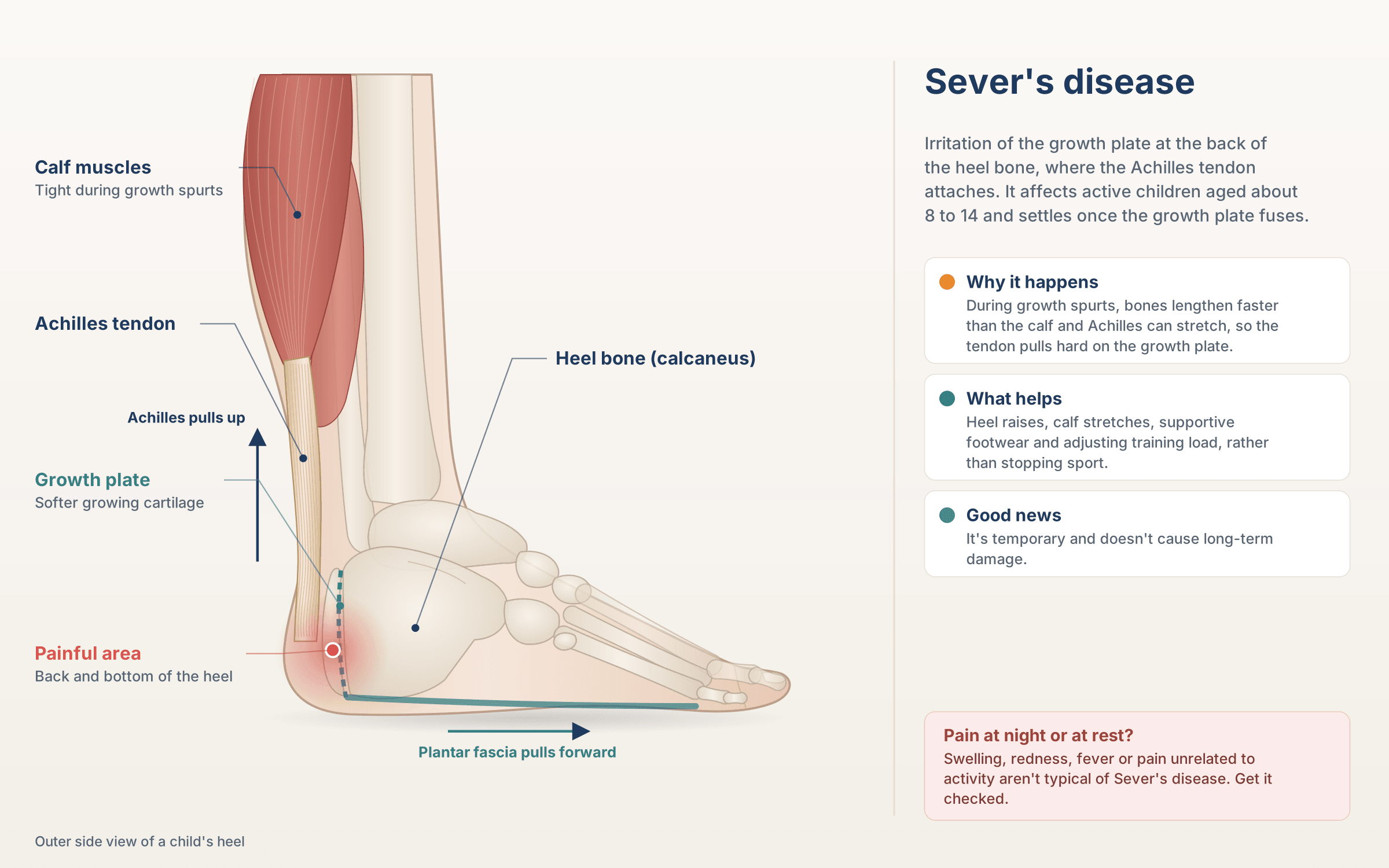
Despite its name, Sever’s disease isn’t really a disease. Its medical name is calcaneal apophysitis: irritation of the growth plate at the back of the heel bone, where the Achilles tendon attaches.
In growing children, the back of the heel bone is joined to the rest of the bone by a plate of softer growing cartilage. During a growth spurt, the bones often grow faster than the calf muscles and Achilles tendon can stretch, so the tendon pulls hard on this growth plate. Add repeated running and jumping, and the growth plate becomes irritated and painful.
Sever’s disease usually affects children aged around 8 to 14, often girls a little younger than boys. It settles once the growth plate fuses, usually in the early to mid teens, and doesn’t cause long-term problems.
What causes Sever’s disease?
- Growth spurts, when bones lengthen faster than the calf muscles and Achilles tendon
- Running and jumping sports, such as soccer, netball, basketball, Oz Tag, athletics, gymnastics and dance
- Hard surfaces, and sudden increases in training, such as the start of a new season or several sports at once
- Tight calf muscles
- Footwear, such as worn-out shoes, flat school shoes or football boots with little heel support
- Foot posture, such as flat feet or feet that roll in
Symptoms to look out for
- Pain at the back or bottom of the heel, during or after sport
- Limping, especially at the end of the day or after training
- Walking or running on the toes to avoid putting the heel down
- Pain when the sides of the heel are squeezed
- Stiffness first thing in the morning
- Pain in one or both heels
See us or your GP promptly if your child has heel pain at night or at rest, swelling or redness, fever, pain after a fall, or pain that isn’t related to activity. These aren’t typical of Sever’s disease and need checking.
How is Sever’s disease diagnosed?
Sever’s disease is usually diagnosed from your child’s history and an examination, without the need for X-rays. Your podiatrist will check where the heel is tender, squeeze the sides of the heel, assess calf flexibility and strength, and watch your child walk and run. We also look at their school shoes and sports footwear. X-rays are only needed if the symptoms are unusual, to rule out other causes.
How we treat Sever’s disease
The aim is to settle the pain and keep your child active, rather than stopping sport altogether.
- Activity modification. Adjusting how much running and jumping your child does while the heel settles, such as reducing training sessions, or playing in a less demanding position, rather than stopping completely. We use a simple pain guide so your child and you know when to ease back.
- Heel raises or cushions in school and sports shoes, to reduce the pull of the Achilles on the growth plate.
- Custom orthotics, where flat feet or rolling in are adding to the strain.
- Calf stretching and strengthening, pitched at the right level for a growing child.
- Footwear advice for school, sport and football boots.
- Ice and strapping after sport, for short-term relief.
- Rest for flare-ups. For a severe flare-up, a short break from running sports, or occasionally a walking boot, may be needed.
We’ll also talk with you about planning around busy sporting seasons, and can liaise with coaches if that helps.
How long does Sever’s disease last?
Each episode usually settles within a few weeks to a few months with the right management, but it can come and go during growth spurts until the growth plate fuses. With heel raises, the right footwear and sensible load management, most children can keep playing the sports they love.
Watch Dr Ozan Amir explain
My 10 Year Old Has Sever’s Disease (Calcaneal Apophysitis)
Sever’s Disease (Children’s Heel Pain) FAQs
Usually not. Most children can keep playing with some changes to how much they train, plus heel raises and stretching. During a bad flare-up, a short break from running sports may help.
No. Sever’s disease settles once the growth plate fuses, usually in the early to mid teens, and doesn’t cause lasting problems.
Usually not. Sever’s disease is diagnosed from the history and examination. We only arrange an X-ray if the symptoms are unusual.
Sever’s disease can flare up during growth spurts and busy sporting seasons. Keeping up stretches, heel raises and good footwear helps reduce flare-ups.
Supportive shoes with a slight heel and good cushioning. Flat school shoes and some football boots can make symptoms worse. We’ll check your child’s shoes and give specific advice.
No, you can book directly. If your appointment is through a Medicare care plan, DVA or another funded program, you’ll need a referral, so check with us when you book.
Serving Manly and the Northern Beaches.
Manly Foot Clinic is at Shop 3/3 Corrie Rd, North Manly NSW 2100. We see patients from Manly, Balgowlah, Freshwater, Dee Why and Brookvale through to Mosman, Neutral Bay, Chatswood and the wider North Shore.