
What is an ankle sprain?
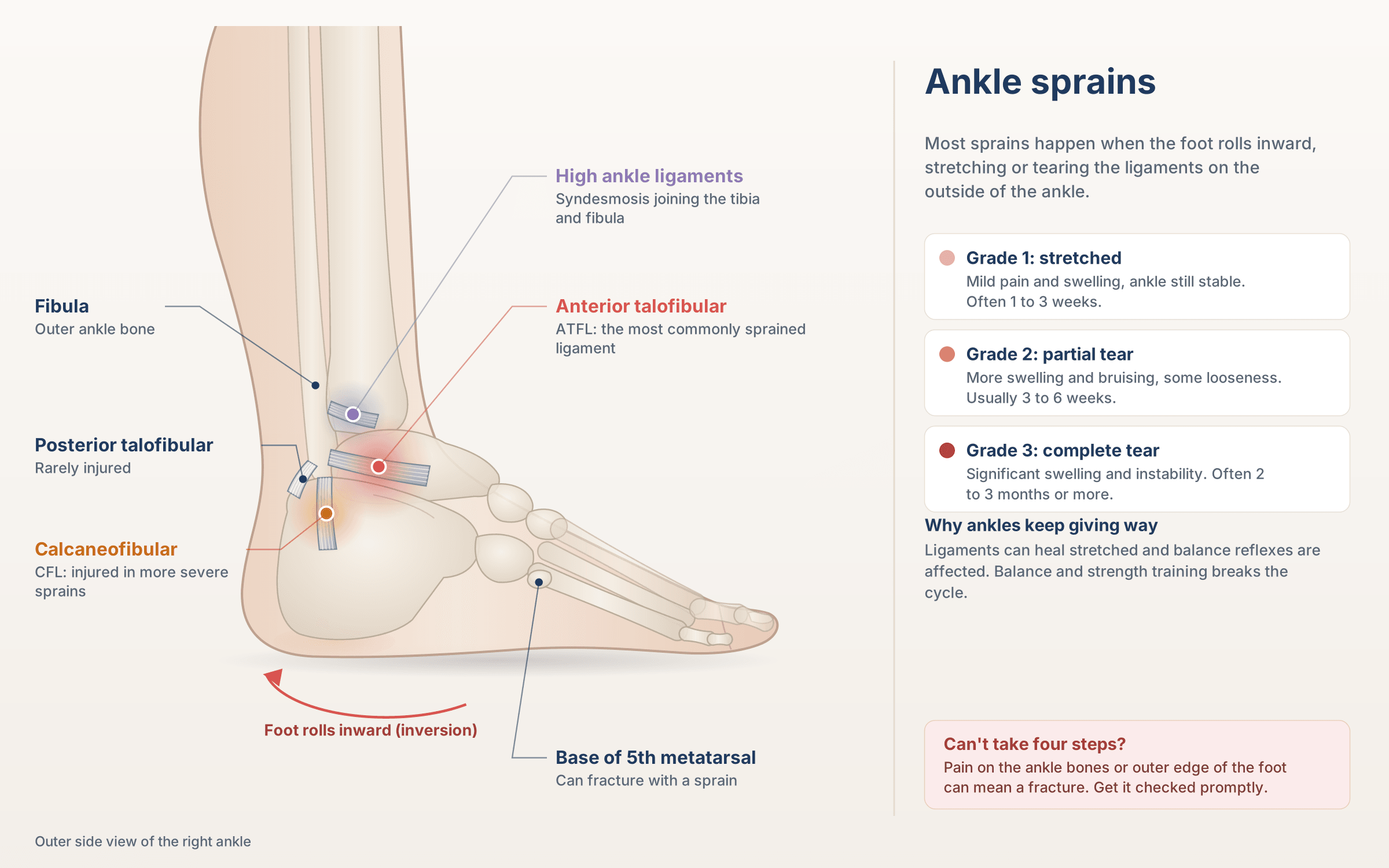
An ankle sprain is an injury to the ligaments that hold the ankle bones together. Most sprains happen when the foot rolls inward (an inversion sprain), stretching or tearing the ligaments on the outside of the ankle. The ligament injured most often is the anterior talofibular ligament (ATFL), followed by the calcaneofibular ligament (CFL).
Grades of sprain
- Grade 1 (mild): the ligament is stretched, with mild pain and swelling and little loss of stability.
- Grade 2 (moderate): a partial tear, with more swelling, bruising and some looseness in the joint.
- Grade 3 (severe): a complete tear, with significant swelling, bruising and instability.
High ankle sprains
A high ankle sprain injures the ligaments that join the two lower leg bones (the syndesmosis), just above the ankle. It’s often caused by the foot twisting outward, common in contact sports. High ankle sprains usually take longer to recover than ordinary sprains and need a different plan, so it’s important they’re picked up early.
Chronic ankle instability
Chronic ankle instability is when the ankle keeps rolling or feels like it might give way, months after the original injury. It happens when the ligaments heal stretched, and when balance and the ankle’s protective reflexes aren’t retrained. Each new sprain increases the chance of another, so breaking the cycle with proper rehabilitation matters.
What causes ankle sprains?
- Uneven ground, stepping off a kerb or landing on someone’s foot
- Sports with jumping, cutting and change of direction, such as netball, basketball, football and touch
- A previous sprain that wasn’t fully rehabilitated, the biggest risk factor for another one
- Weak calf and peroneal muscles and poor balance
- Foot shape, such as high arches, which tilt the ankle outward
- Footwear with poor support, or high heels
Symptoms to look out for
- Pain and swelling on the outside of the ankle
- Bruising that can track down into the foot
- Difficulty putting weight on the foot
- Stiffness and reduced movement
- An ankle that feels loose, wobbly or keeps giving way (instability)
- Ongoing pain months after a sprain, which may mean other damage, such as a cartilage injury or a tendon problem
See someone promptly if you can’t take four steps on the ankle, have pain on the bony points of the ankle or the outer edge of the foot, or the ankle looks deformed. These can be signs of a fracture.
How are ankle sprains diagnosed?
Your podiatrist will ask how the injury happened and examine the ankle, testing each ligament for tenderness and stability. We use the Ottawa ankle rules to decide whether an X-ray is needed to rule out a fracture. For severe sprains, high ankle sprains or ankles that aren’t recovering as expected, we arrange an ultrasound or MRI to check the ligaments, tendons and joint surface. We also check your balance, calf strength and foot structure, which all influence recovery and the risk of re-injury.
Stage 1: protect and settle (first few days)
- Protection, with strapping, a brace or, for severe sprains, a short period in a walking boot
- Ice, compression and elevation to control swelling
- Early, gentle movement and walking as comfort allows, which helps healing more than complete rest
Stage 2: restore movement and strength
- Range of motion exercises to restore ankle movement
- Strengthening for the calf and peroneal muscles, which protect the outside of the ankle
- Balance and proprioception training, such as single-leg balance work, which is the key to preventing future sprains
Stage 3: return to sport
- Sport-specific drills, including hopping, landing and change of direction
- Taping or bracing for the first few months back at sport
- A clear return-to-sport checklist, so you go back when the ankle is ready, not just when the pain has gone
Stage 4: when the ankle keeps giving way
If your ankle remains unstable despite a thorough rehabilitation program, Dr Ozan Amir, Surgical Podiatrist, can assess whether surgery is an option. Surgical repair or reconstruction of the lateral ankle ligaments can restore stability. We’ll also look for other causes of ongoing pain, such as a cartilage injury, a peroneal tendon tear or impingement, which can need their own treatment.
How long does an ankle sprain take to heal?
- Grade 1: often 1 to 3 weeks
- Grade 2: usually 3 to 6 weeks
- Grade 3 or a high ankle sprain: often 2 to 3 months or more
Ligaments keep remodelling for months after the pain settles, which is why finishing your balance and strengthening program, rather than stopping when it feels better, is what prevents the next sprain.
Ankle sprains in children
Children’s ligaments are often stronger than their growth plates, so an injury that looks like a sprain in a child can sometimes be a growth plate injury. We have a low threshold for X-rays in children with significant ankle injuries.
Watch Dr Ozan Amir explain
Part I: Josh (a Sydney-based Podiatrist) Presents with Chronic Ankle Instability
Resolution of Peroneal Spasm with a Sinus Tarsi Block
Surface Anatomy of the Lateral Foot
Ankle Sprains & Instability FAQs
Not always. We use the Ottawa ankle rules, a set of simple checks, to decide whether an X-ray is needed. If you can’t walk four steps or have pain on specific bony points, we’ll arrange one.
After the first day or two, gentle movement and walking as comfort allows usually help healing. Complete rest for long periods can leave the ankle stiff and weak.
After a sprain, the ligaments can heal stretched, and the nerves that help your ankle sense its position are affected. Without balance training, the ankle is more likely to roll again. A structured rehabilitation program usually helps.
Taping or bracing for the first few months back at sport reduces the risk of another sprain. Long term, strength and balance training are the best protection.
Only when the ankle remains unstable after a thorough rehabilitation program, or if there’s other damage, such as a significant cartilage or tendon injury.
No, you can book directly. If your appointment is through a Medicare care plan, DVA or another funded program, you’ll need a referral, so check with us when you book.
Serving Manly and the Northern Beaches.
Manly Foot Clinic is at Shop 3/3 Corrie Rd, North Manly NSW 2100. We see patients from Manly, Balgowlah, Freshwater, Dee Why and Brookvale through to Mosman, Neutral Bay, Chatswood and the wider North Shore.