
What is the plantar plate?
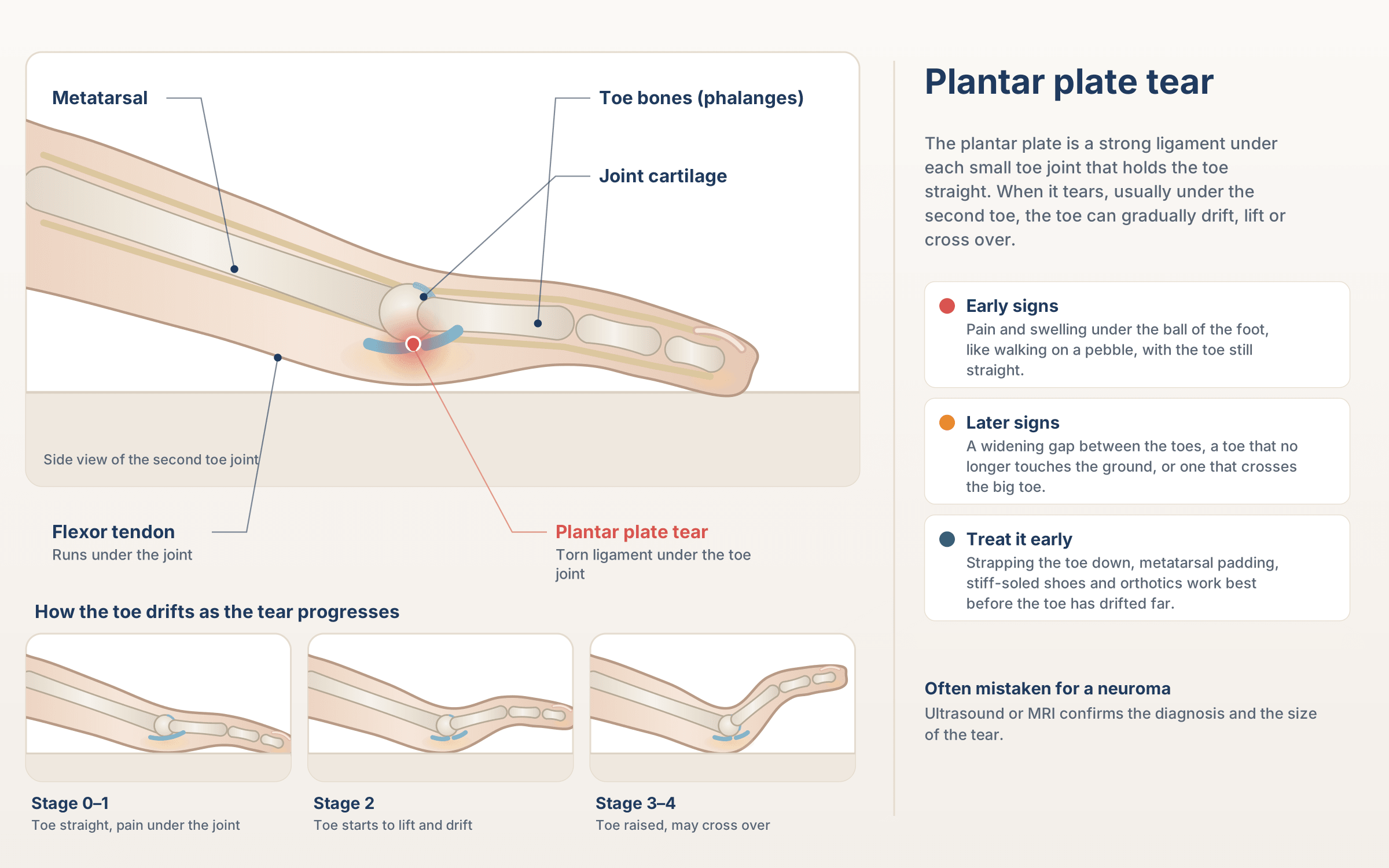
The plantar plate is a strong, thick ligament on the underside of each of the small toe joints (the metatarsophalangeal joints), where the toes meet the foot. It stops the toe bending too far upward and holds the toe in a straight position, acting as the joint’s main stabiliser.
When the plantar plate is overloaded, it can stretch, become inflamed or tear. It’s most common under the second toe, which often takes the most load, especially in people with bunions or a long second metatarsal.
How a plantar plate tear progresses
- Stage 0 to 1: pain and swelling under the joint, with the toe still straight
- Stage 2: the toe begins to drift towards the big toe or lift slightly, and a gap may appear between the toes
- Stage 3 to 4: the toe sits noticeably raised or crosses over the big toe, and may dislocate
The earlier it’s treated, the better the chance of avoiding a permanent toe deformity.
What causes plantar plate tears?
- Repetitive overload of the forefoot, such as running, dancing or long hours on your feet
- High heels, which bend the toes upward and push weight onto the ball of the foot
- Bunions, which shift load from the big toe onto the second toe
- A long second metatarsal or a tight calf, which increase forefoot pressure
- Hammer toes and claw toes
- Inflammatory arthritis, which can weaken the ligament
- A sudden injury, such as stubbing or forcing the toe upward
Symptoms to look out for
- Pain and swelling under the ball of the foot, usually beneath the second toe
- A feeling of walking on a pebble or a bunched-up sock
- Pain when pushing off, walking barefoot or wearing heels
- Swelling on top of the joint
- A toe that drifts sideways, lifts up, or no longer touches the ground
- A widening gap between the second and third toes
- A toe that crosses over the big toe in more advanced cases
How is a plantar plate tear diagnosed?
Your podiatrist will examine the forefoot to find exactly where it’s tender, and perform a drawer test, gently moving the toe up and down to check for instability. We also check whether the toe can grip the floor, and look for drifting or gaps between the toes. An ultrasound or MRI confirms the diagnosis and shows the size of the tear, and an X-ray assesses the toe alignment and the length of the metatarsals.
Because plantar plate pain and a Morton’s neuroma can feel very similar, getting the diagnosis right before treatment is important.
Early tears (toe still straight or slightly drifting)
- Strapping the toe in a downward position, to rest the plantar plate and let it heal
- Metatarsal padding to take load off the joint
- Stiff-soled or rocker-soled shoes, and a break from high heels and barefoot walking
- Custom orthotics, made from a 3D scan of your feet, to offload the forefoot long term
- Activity changes, reducing high-impact exercise while it heals
- Toe and calf exercises once the pain settles
Strapping is usually continued for several weeks, so the ligament can heal in the right position.
Tears that don’t heal, or a toe that has become unstable
If the toe keeps drifting, becomes unstable or doesn’t settle with thorough treatment, Dr Ozan Amir, Surgical Podiatrist, can assess whether surgery is an option. Depending on the problem, surgery may include repairing the plantar plate, straightening the toe, shortening a long metatarsal to reduce load on the joint, and correcting an associated bunion or hammer toe at the same time.
We avoid corticosteroid injections into the toe joint for plantar plate tears, as they can weaken the ligament further.
How long does a plantar plate tear take to heal?
Mild tears often settle over 6 to 12 weeks of strapping, offloading and footwear changes. More significant tears and those that need surgery take longer. Your podiatrist will review progress regularly and adjust the plan.
Watch Dr Ozan Amir explain
This Is What the Plantar Plate Looks Like
Which Is It? Neuroma or Plantar Plate Pathology
Surgical Correction of Hammertoe Deformity
Plantar Plate Tear FAQs
They can feel similar. A neuroma usually causes burning, tingling or numbness between the toes. A plantar plate tear causes pain under the toe joint, often with swelling and a toe that’s starting to drift. An examination, plus ultrasound or MRI, tells them apart.
In early tears, strapping can help the ligament heal with the toe in a good position. Once a toe has drifted significantly or crossed over, it usually won’t straighten without surgery.
Usually, with changes. Low-impact exercise like cycling or swimming is fine while high-impact activity is reduced. We’ll guide you on what’s safe.
We avoid injecting corticosteroid into the toe joint for plantar plate tears, as it can weaken the ligament further and increase the risk of the toe dislocating.
No, you can book directly. If your appointment is through a Medicare care plan, DVA or another funded program, you’ll need a referral, so check with us when you book.
Serving Manly and the Northern Beaches.
Manly Foot Clinic is at Shop 3/3 Corrie Rd, North Manly NSW 2100. We see patients from Manly, Balgowlah, Freshwater, Dee Why and Brookvale through to Mosman, Neutral Bay, Chatswood and the wider North Shore.