What is a ganglion cyst?
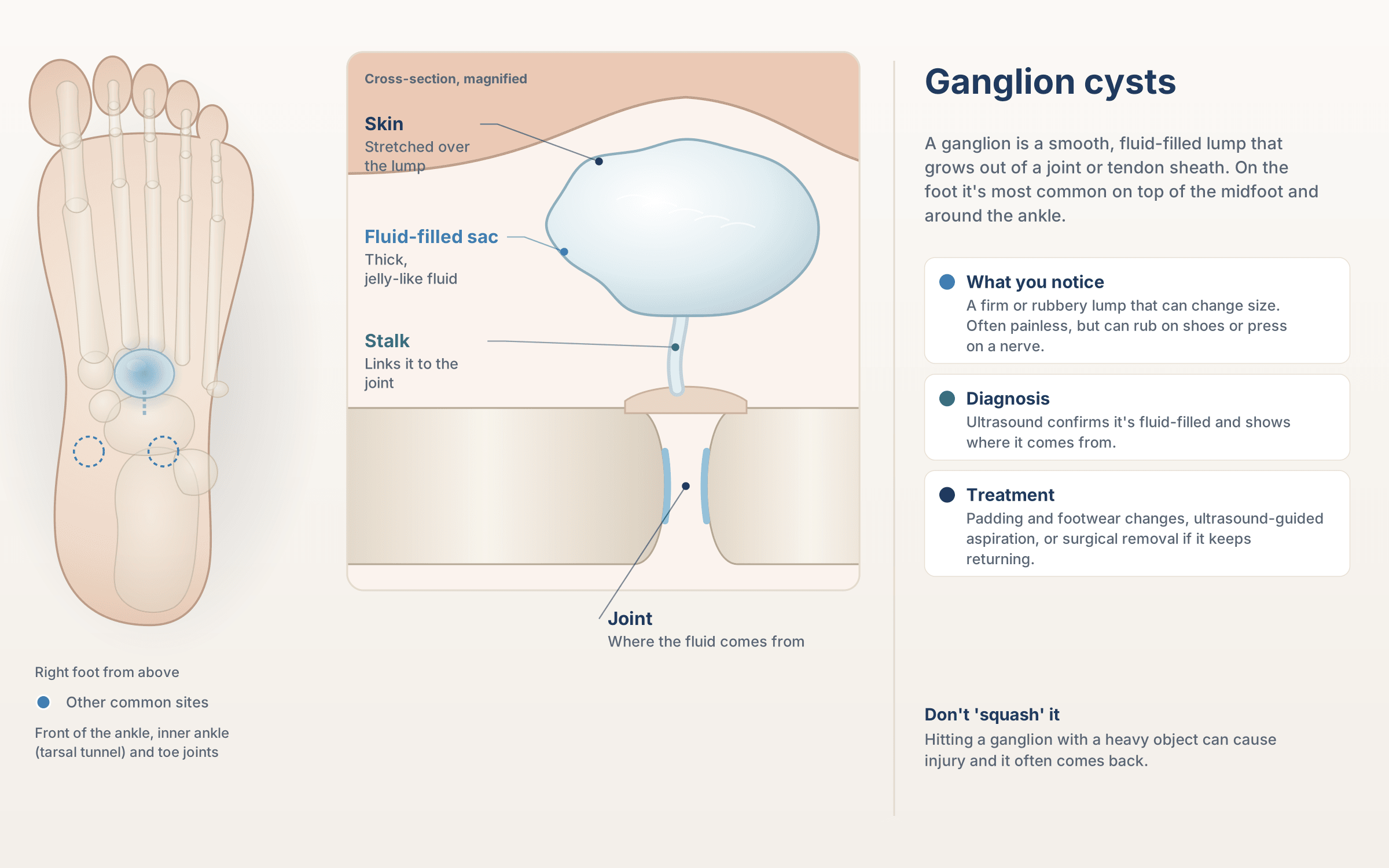
A ganglion cyst is a sac filled with thick, clear, jelly-like fluid, similar to the fluid that lubricates joints and tendons. It forms when this fluid leaks out of a joint capsule or tendon sheath through a weak spot and collects in a pouch, connected to the joint or tendon by a stalk.
In the foot and ankle, ganglions most often appear:
- On the top of the foot, over the midfoot joints
- Around the ankle, at the front or sides
- Near the toes
- Inside the tarsal tunnel, on the inside of the ankle, where they can press on the tibial nerve
Ganglions can change size, getting bigger with activity and smaller with rest, and sometimes disappear on their own.
Other lumps on the foot
Not every lump is a ganglion. Other lumps we see include plantar fibromas (firm nodules in the arch), myxoid cysts (near the toenail), lipomas, bursae, gouty tophi and, rarely, other soft tissue growths. Any lump that’s growing quickly, very firm, painful at rest or fixed should be assessed.
What causes ganglion cysts?
The exact cause isn’t always known, but they’re linked to:
- Joint or tendon irritation, from repetitive movement or pressure
- Previous injury, such as an ankle sprain
- Arthritis in the nearby joint
- Footwear pressure over the top of the foot
They’re more common in women and in people aged 20 to 50.
Symptoms to look out for
- A soft or firm, rounded lump under the skin
- A lump that changes size
- Discomfort or rubbing in shoes, especially from laces or straps
- Tingling, numbness or burning if the cyst presses on a nerve
- Pain or aching in the nearby joint or tendon
- Many ganglions are painless
How are ganglion cysts diagnosed?
Your podiatrist will examine the lump, checking its size, firmness and whether it moves, and may shine a light through it, as ganglions often glow (transilluminate). Ultrasound confirms that the lump is fluid-filled and shows where it’s coming from, and rules out other causes. An X-ray may be used to check for arthritis in the joint underneath, and an MRI is sometimes needed for deeper cysts, such as in the tarsal tunnel.
Watch and protect
Small, painless ganglions often don’t need treatment, and some disappear on their own. We can help with:
- Padding to protect the lump from shoe pressure
- Footwear changes, such as different lacing patterns that avoid the cyst
- Monitoring for changes
Ultrasound-guided drainage (aspiration)
For painful or bothersome ganglions, the fluid can be drained through a needle under local anaesthetic. Using ultrasound guidance means the needle is placed precisely. A corticosteroid may be injected afterwards to reduce the chance of the cyst refilling. Drainage is quick, but ganglions can come back, as the stalk remains.
Surgical removal
If a ganglion keeps returning, is painful or is pressing on a nerve, Dr Ozan Amir, Surgical Podiatrist, can assess whether surgery is an option. Surgery removes the whole cyst and its stalk, and sometimes repairs the joint capsule or tendon sheath it came from, which lowers the chance of it returning. Ganglions in the tarsal tunnel are removed as part of a tarsal tunnel release.
Minor procedures are performed at the clinic, and deeper or more complex cysts in a day surgery hospital. Ozan will explain the procedure, the recovery and the risks before anything is booked.
Watch Dr Ozan Amir explain
How Does a Ganglion Cyst Form?
How to Drain a Ganglion Cyst
Ganglion Cyst Drainage Compilation
Sean Undergoes Surgery: Excision of a Ganglion Cyst Within the Tarsal Tunnel
Excision of Plantar Fibroma
Excision of Myxoid Cysts
Superficial Acral Fibromyxoma – A Rare Lesion
Ganglion Cysts FAQs
No. Ganglion cysts are harmless (benign). An ultrasound confirms the diagnosis and rules out other types of lump.
No. The old remedy of smashing a ganglion can injure the foot and the cyst often comes back. Drainage or surgery are safer options.
It can, because the stalk connecting the cyst to the joint remains. Surgical removal of the cyst and its stalk has a lower chance of recurrence.
Not always. Small, painless ganglions can be left alone. Treatment is worthwhile if it’s painful, affecting your footwear or pressing on a nerve.
No, you can book directly. If your appointment is through a Medicare care plan, DVA or another funded program, you’ll need a referral, so check with us when you book.
Serving Manly and the Northern Beaches.
Manly Foot Clinic is at Shop 3/3 Corrie Rd, North Manly NSW 2100. We see patients from Manly, Balgowlah, Freshwater, Dee Why and Brookvale through to Mosman, Neutral Bay, Chatswood and the wider North Shore.