
What is a stress fracture?
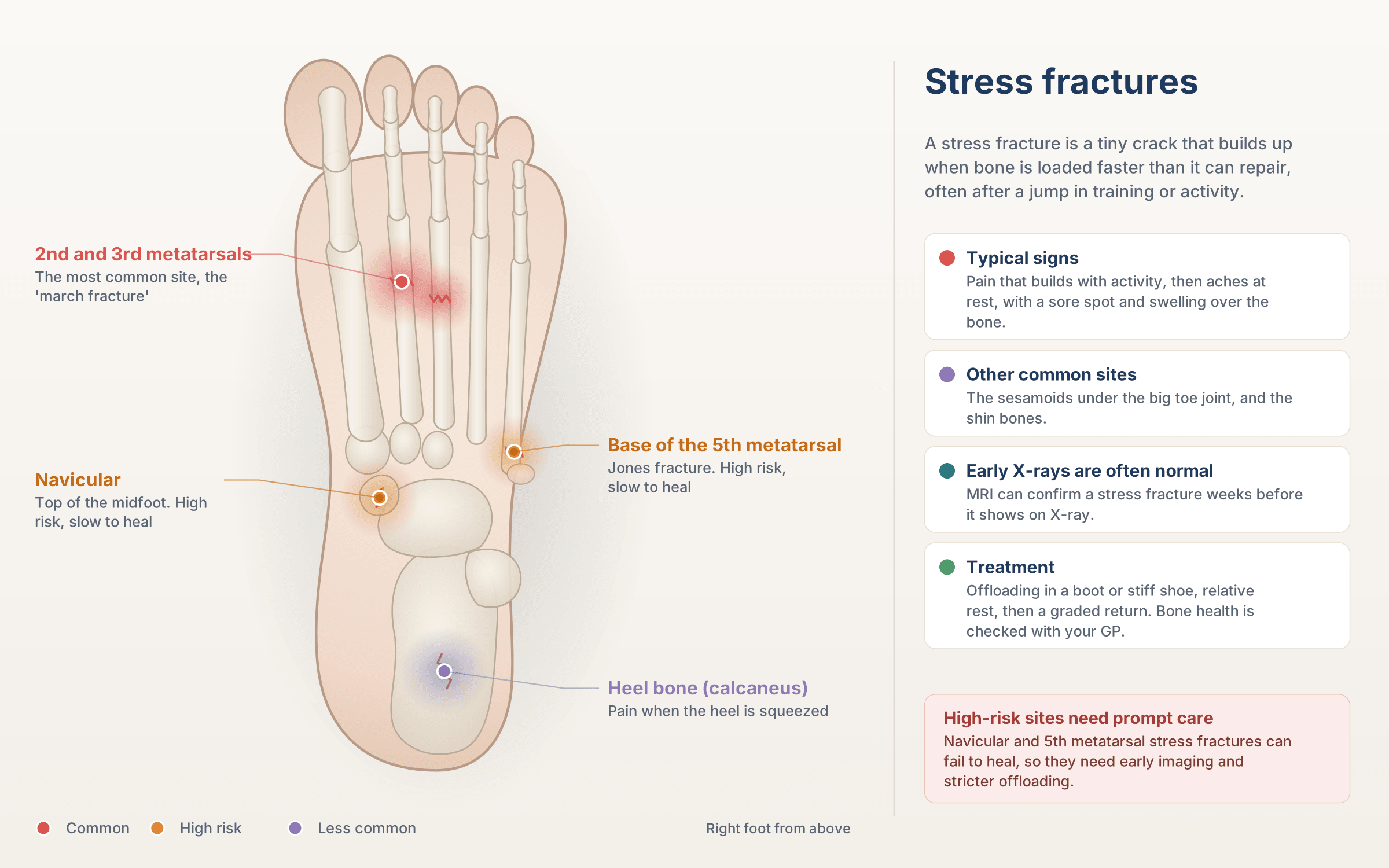
Bone is constantly remodelling: breaking down and rebuilding in response to the loads you put through it. When the load increases faster than the bone can adapt, small areas of damage build up. At first this is a bone stress reaction, and if the loading continues, it can progress to a stress fracture, a fine crack in the bone.
Common stress fracture sites in the foot and ankle
- Metatarsals: most often the second and third, the classic “march fracture”
- Heel bone (calcaneus): pain on squeezing the sides of the heel
- Navicular: pain on the top of the midfoot, common in sprinting and jumping sports
- Base of the fifth metatarsal (Jones fracture): on the outer edge of the foot
- Sesamoids: under the big toe joint
- Tibia and fibula: the shin bones
Some sites, including the navicular, the base of the fifth metatarsal and the sesamoids, are considered high-risk, because they have a poorer blood supply and are slower to heal. These need careful management and sometimes surgery.
What causes stress fractures?
- Training errors: increasing distance, speed or frequency too quickly, or changing to harder surfaces
- Starting a new activity, such as a walking holiday, a new job on your feet or a fitness program
- Footwear: worn-out or unsupportive shoes
- Foot structure: high arches, flat feet, bunions or a short first metatarsal
- Low bone density (osteopenia or osteoporosis)
- Low energy availability: not eating enough to match training (sometimes called RED-S), which affects bone health
- Low vitamin D and calcium
- Hormonal factors, including irregular or absent periods in women and menopause
- Smoking and some medications
Symptoms to look out for
- Pain that builds gradually over days or weeks, rather than starting with a single injury
- Pain during activity that eases with rest, then pain with everyday walking as it progresses
- A specific spot that’s tender when you press on the bone
- Swelling on the top of the foot or around the area
- Pain at night or at rest in more advanced cases
If you have pain in one spot on a bone that’s getting worse with activity, stop running and get it assessed. Continuing to train on a stress fracture can turn it into a complete break.
How are stress fractures diagnosed?
Your podiatrist will ask about your training, footwear and general health, and press along the bones to find the painful spot. Early stress fractures often don’t show on X-ray for 2 to 3 weeks, so if a stress fracture is suspected, we arrange an MRI, which can show bone stress before a crack is visible. A follow-up X-ray can confirm healing.
We’ll also look for the reasons behind it, including your foot structure, footwear, training load and, where relevant, bone health. We may suggest your GP checks your vitamin D, bone density or hormones.
Protect the bone
- Offloading: a walking boot or stiff-soled shoe, usually for 4 to 6 weeks for a metatarsal stress fracture
- Crutches for more painful fractures or high-risk sites
- Relative rest: stopping running and impact activity, while keeping fit with cycling, swimming or deep-water running if comfortable
Find and fix the cause
- Training review: adjusting volume, surfaces and recovery days
- Footwear advice and replacing worn shoes
- Custom orthotics, made from a 3D scan of your feet, to spread load more evenly
- Strength training for the feet, calves and hips
- Bone health: working with your GP on vitamin D, calcium, energy intake and bone density where needed
Return to running
Once the bone is pain-free with walking and hopping, and healing is confirmed, we guide a gradual return to running: starting with walk-run intervals and building slowly over several weeks, with clear milestones.
High-risk fractures
Fractures of the navicular, the base of the fifth metatarsal (Jones fracture) and the sesamoids may need a longer period non-weight-bearing. If they don’t heal, Dr Ozan Amir, Surgical Podiatrist, can assess whether surgical fixation is an option.
How long do stress fractures take to heal?
Most metatarsal stress fractures heal in 6 to 8 weeks, with a gradual return to running over the following weeks. High-risk fractures can take three months or more. Returning too early is the most common reason for a fracture failing to heal or recurring.
Watch Dr Ozan Amir explain
Fracture of the Fibular Sesamoid of the Great Toe – Anatomy and Surgical Excision
Thirteen Weeks After Fibular Sesamoid Excision – Post-operative Recovery
Stress Fractures FAQs
Early stress fractures often don’t show on X-ray for 2 to 3 weeks. An MRI can detect bone stress much earlier.
Usually, in a walking boot or stiff-soled shoe, for most metatarsal stress fractures. High-risk fractures may need crutches. We’ll tell you exactly what’s safe.
By finding the cause: building training gradually, wearing the right footwear, strengthening your feet and legs, and addressing bone health, nutrition or foot mechanics where needed.
Possibly, if you’ve had more than one stress fracture, have risk factors for low bone density, or the fracture happened with only a modest increase in activity. We’ll discuss this with you and your GP.
No, you can book directly. If your appointment is through a Medicare care plan, DVA or another funded program, you’ll need a referral, so check with us when you book.
Serving Manly and the Northern Beaches.
Manly Foot Clinic is at Shop 3/3 Corrie Rd, North Manly NSW 2100. We see patients from Manly, Balgowlah, Freshwater, Dee Why and Brookvale through to Mosman, Neutral Bay, Chatswood and the wider North Shore.