What is a Morton’s neuroma?
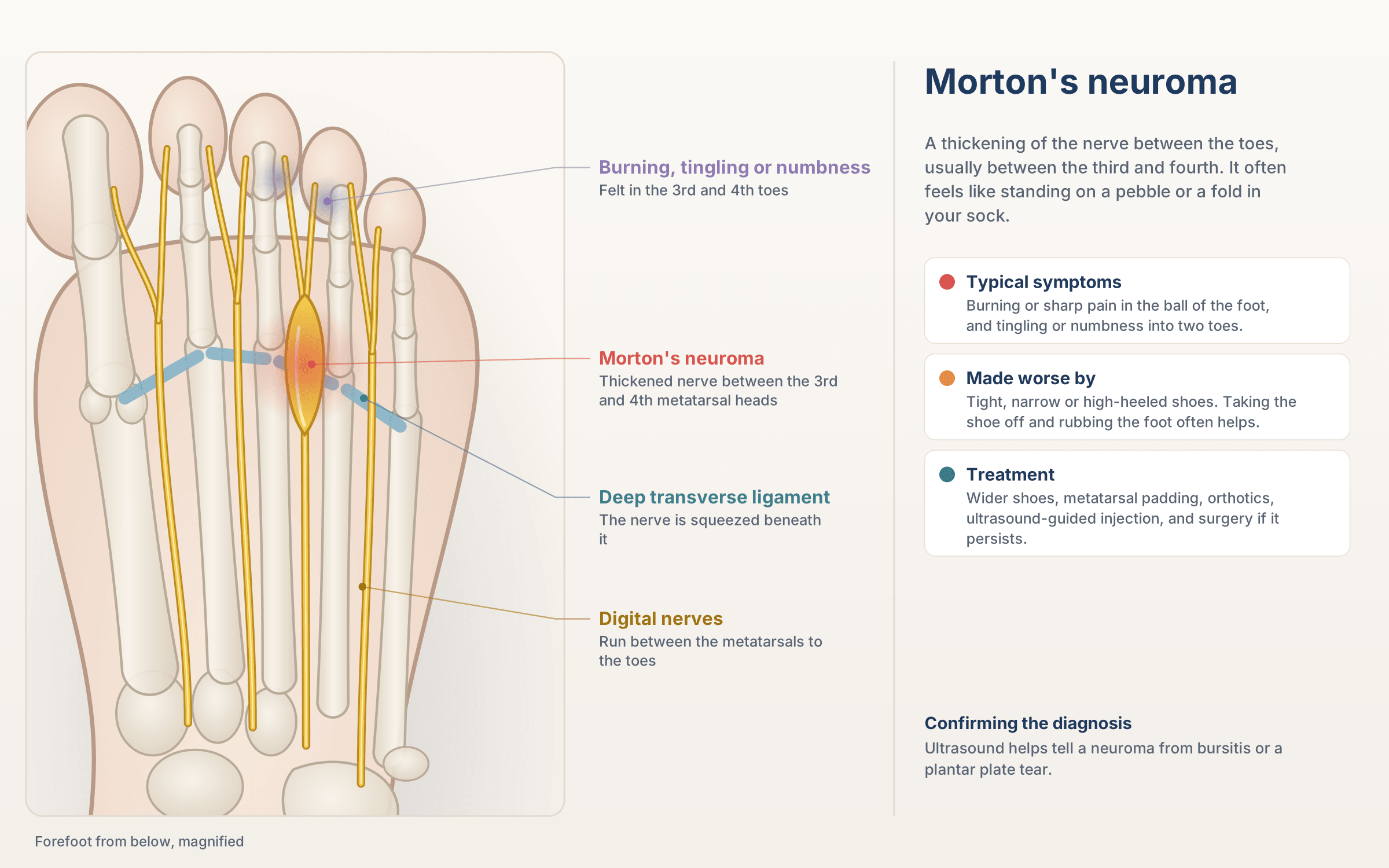
A Morton’s neuroma is a thickening of the tissue around one of the small nerves that run between the long bones of the forefoot (the metatarsals) to the toes. It’s not a true tumour, but a benign enlargement caused by the nerve being repeatedly compressed and irritated.
It most often develops between the third and fourth toes, and sometimes between the second and third. As the nerve thickens, it takes up more space and is squeezed even more, so symptoms often gradually get worse.
What causes Morton’s neuroma?
- Footwear: narrow, tight or pointed shoes and high heels, which squeeze the forefoot and push weight onto the ball of the foot
- High-impact sports: running, court sports and dance
- Tight-fitting sports shoes, such as ski boots, climbing shoes and cycling shoes
- Foot structure: flat feet, high arches, bunions and hammer toes
- Inflamed bursae between the metatarsal heads
- Injury to the forefoot
Symptoms to look out for
- Burning, sharp or shooting pain in the ball of the foot, often spreading into the toes
- Tingling, pins and needles or numbness in two adjacent toes
- A feeling of walking on a pebble, marble or a bunched-up sock
- Pain that’s worse in tight shoes, heels or with activity
- Relief when you take your shoe off and rub your foot
- A clicking sensation between the toes
How is Morton’s neuroma diagnosed?
Morton’s neuroma is mainly diagnosed from your history and an examination. Your podiatrist will squeeze the forefoot from side to side and press between the metatarsal heads to reproduce the pain, sometimes with a click (Mulder’s click). We also check the toe joints for a plantar plate tear and the bones for a stress fracture, which can cause similar pain.
A high-resolution ultrasound or MRI can confirm the neuroma and its size, and rule out other causes. These scans aren’t perfect, so the diagnosis is always made together with the examination.
Step 1: take the pressure off the nerve
- Footwear: shoes with a wide, deep toe box, a low heel and a cushioned or rocker sole
- Metatarsal padding, placed behind the metatarsal heads to spread them apart and take pressure off the nerve
- Custom orthotics, made from a 3D scan of your feet, with a metatarsal dome built in
- Activity changes, reducing high-impact exercise while it settles
- Ice and anti-inflammatory gels for short-term relief
Step 2: injection therapy
If symptoms persist, an injection can reduce the inflammation around the nerve. Dr Rohan Amir, who is endorsed for scheduled medicines, provides corticosteroid injections under ultrasound guidance, so the medication is placed precisely around the neuroma. Some people need more than one injection, spaced several weeks apart.
Step 3: surgery
If pain continues despite thorough non-surgical treatment, Dr Ozan Amir, Surgical Podiatrist, can assess whether surgery is an option. The usual procedure is a neurectomy: removing the thickened section of nerve. This can be done through an incision on the top of the foot (dorsal approach) or the sole (plantar approach), and Ozan will explain which suits you. Burying the cut end of the nerve in muscle helps reduce the risk of a painful stump neuroma forming.
Neuroma surgery is usually performed under general anaesthetic in a day surgery facility. Afterwards, you keep the foot dry for about two weeks and can usually walk early in a post-operative shoe. Some numbness between the two affected toes is expected afterwards, because the nerve has been removed. Ozan will discuss the expected recovery and risks with you, including the small chance of a recurrent neuroma.
After surgery, Ozan works with your podiatrist on orthotic therapy, to address the foot mechanics that contributed to the neuroma.
How long does it take to settle?
Many people improve within a few weeks to a few months with footwear changes, padding and orthotics. An injection often gives relief within a couple of weeks. After surgery, most people return to normal shoes within several weeks.
Watch Dr Ozan Amir explain
Morton’s Neuroma Excision Through a Plantar Approach
Injection Therapy for Long-standing Neuroma
Which Is It? Neuroma or Plantar Plate Pathology
Morton's Neuroma FAQs
No. It’s a benign thickening of the tissue around a nerve, caused by compression and irritation. It isn’t cancerous.
It’s unlikely to disappear on its own, but symptoms often settle with footwear changes, padding, orthotics and, if needed, an injection.
They can feel similar. A neuroma typically causes burning, tingling or numbness between two toes, while a plantar plate tear causes pain under the toe joint, often with a toe that’s drifting. An examination and scan tell them apart.
Yes, some numbness between the two affected toes is expected, because the nerve is removed. Most people find it doesn’t bother them.
Often, with changes to footwear and lacing, padding and reduced training while it settles. We’ll guide you at your assessment.
No, you can book directly. If your appointment is through a Medicare care plan, DVA or another funded program, you’ll need a referral, so check with us when you book.
Serving Manly and the Northern Beaches.
Manly Foot Clinic is at Shop 3/3 Corrie Rd, North Manly NSW 2100. We see patients from Manly, Balgowlah, Freshwater, Dee Why and Brookvale through to Mosman, Neutral Bay, Chatswood and the wider North Shore.