
What are the peroneal tendons?
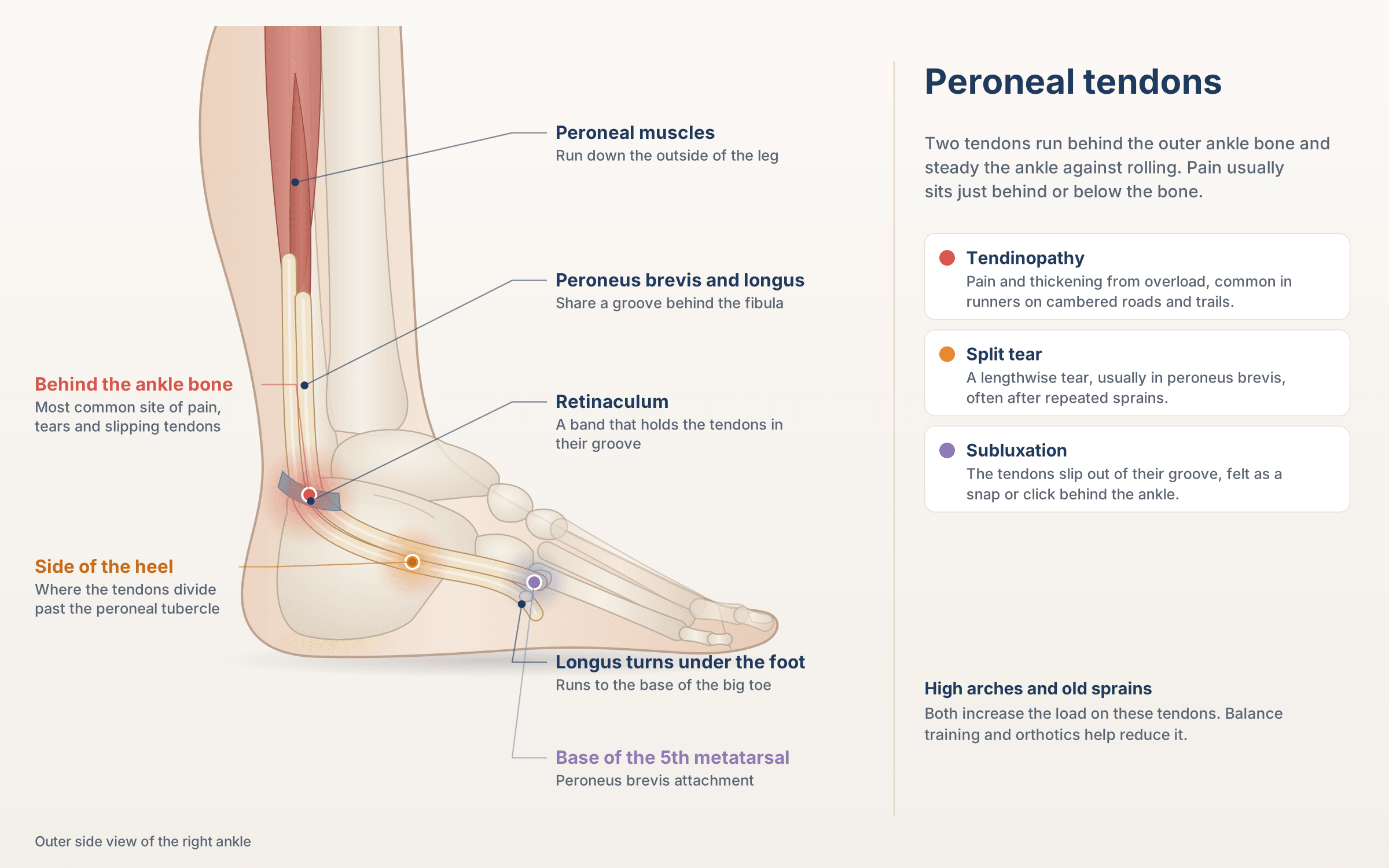
There are two peroneal tendons, peroneus longus and peroneus brevis. They run from muscles on the outside of the lower leg, down behind the bony bump on the outside of the ankle (the lateral malleolus), and into the foot.
- Peroneus brevis attaches to the base of the fifth metatarsal, on the outer edge of the foot.
- Peroneus longus runs under the foot to the base of the big toe.
Together they turn the foot outward and help stop the ankle rolling, which is why they’re so important after an ankle sprain.
Peroneal tendon problems
- Peroneal tendinopathy: pain and thickening of the tendons from overload
- Peroneal tendon tear: a split or tear, most often in peroneus brevis, frequently after ankle sprains
- Peroneal tendon subluxation: the tendons slipping out of their groove behind the ankle bone, often felt as a snapping or clicking
- Painful os peroneum: irritation of a small extra bone that some people have within the peroneus longus tendon
What causes peroneal tendon problems?
- Ankle sprains, especially repeated sprains or chronic ankle instability
- High arches, which tilt the heel outward and overload the tendons
- Overuse: running, particularly on cambered roads or uneven trails, and sports with lots of side-to-side movement
- Sudden increases in training
- Weak peroneal and calf muscles
- Footwear that’s worn on the outside edge or offers poor support
Symptoms to look out for
- Pain and swelling on the outside of the ankle, behind or just below the ankle bone
- Pain along the outer edge of the foot
- Pain that’s worse with activity, especially on uneven ground, and eases with rest
- Tenderness when the tendons are pressed
- An ankle that feels weak or unstable
- A snapping or popping sensation behind the ankle bone (subluxation)
- Pain that persists for weeks after an ankle sprain
How is peroneal tendinopathy diagnosed?
Your podiatrist will examine the outside of the ankle, feeling along the tendons for tenderness, thickening and swelling, and test the strength of the tendons as you turn your foot outward against resistance. We check your ankle stability, foot structure and how you walk and run. An ultrasound or MRI shows the tendons’ structure, and can confirm a tear or subluxation.
Stage 1: settle the tendons
- Load management: adjusting your running, avoiding cambered roads and uneven trails while it settles
- Bracing or strapping to support the ankle and reduce strain on the tendons
- Footwear advice, and replacing shoes worn on the outer edge
- A walking boot, for a short period, for severe pain or tears
Stage 2: rebuild strength and stability
- A progressive loading program for the peroneal and calf muscles, starting with isometric holds and progressing to resistance band and weight-bearing exercises
- Balance and proprioception training to restore ankle stability
- Custom orthotics, made from a 3D scan of your feet, especially for high arches, to reduce the outward tilt of the heel and the strain on the tendons
Stage 3: for pain that won’t settle
- Shockwave therapy for long-standing peroneal tendinopathy, usually over a course of 3 to 5 weekly sessions.
- Ultrasound-guided injection. Corticosteroid isn’t injected into the tendon itself. Where inflammation of the tendon sheath is contributing, Dr Rohan Amir can place an injection precisely into the sheath under ultrasound guidance.
- Surgical opinion. If a tear doesn’t heal, the tendons keep slipping out of place, or pain continues despite thorough treatment, Dr Ozan Amir, Surgical Podiatrist, can assess whether surgery is an option, such as tendon repair, deepening the groove behind the ankle bone, or correcting a high-arched foot.
How long does it take to recover?
Peroneal tendinopathy usually settles over 6 to 12 weeks with a consistent loading program. Tears and subluxation can take longer, especially if surgery is needed. Continuing your strength and balance exercises after the pain settles helps prevent it returning.
Watch Dr Ozan Amir explain
Resolution of Peroneal Spasm with a Sinus Tarsi Block
Surface Anatomy of the Lateral Foot
Part I: Josh Presents with Chronic Ankle Instability
Peroneal Tendinopathy FAQs
Pain on the outside of the ankle can come from either, and they often happen together. If pain lingers for more than a few weeks after a sprain, the peroneal tendons are worth checking.
A snapping sensation behind the ankle bone can mean the peroneal tendons are slipping out of their groove. It’s worth having it assessed, as it can damage the tendons over time.
Often, yes, especially if you have high arches. Orthotics can reduce the outward tilt of the heel and the strain on the tendons.
Often, with changes, such as avoiding cambered roads and trails and reducing distance while it settles. We’ll set a plan at your assessment.
No, you can book directly. If your appointment is through a Medicare care plan, DVA or another funded program, you’ll need a referral, so check with us when you book.
Serving Manly and the Northern Beaches.
Manly Foot Clinic is at Shop 3/3 Corrie Rd, North Manly NSW 2100. We see patients from Manly, Balgowlah, Freshwater, Dee Why and Brookvale through to Mosman, Neutral Bay, Chatswood and the wider North Shore.