What are flat feet?
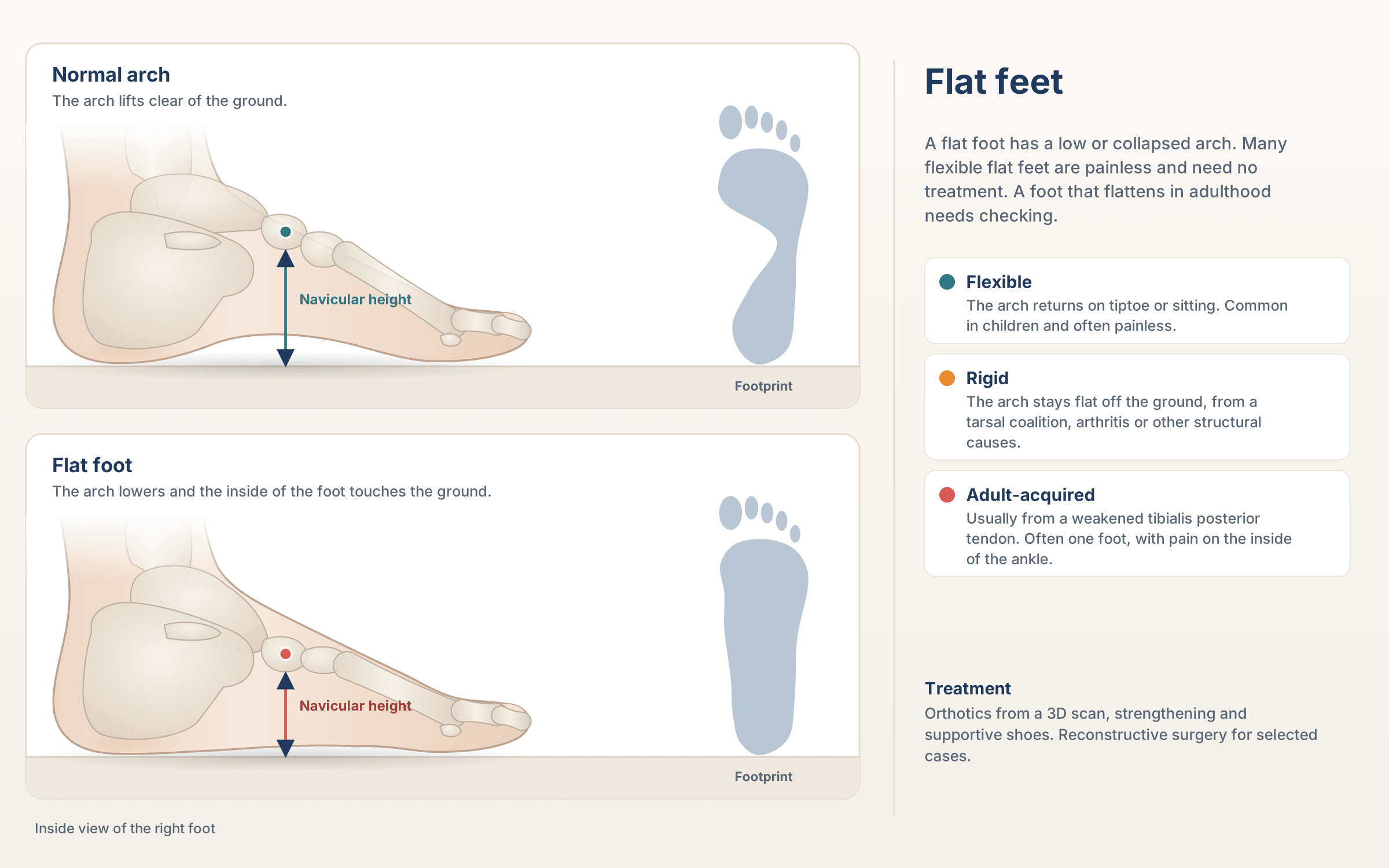
Flat feet (pes planus) means the arch on the inside of the foot is low or collapses when you stand, so most of the sole touches the ground. Often the heel also tilts outward and the foot rolls in (overpronates).
Types of flat feet
- Flexible flat feet: the arch appears when you sit or stand on your toes, and flattens when you stand. This is very common, especially in children, and is often painless.
- Rigid flat feet: the arch stays flat even off the ground. This can be caused by a tarsal coalition (two bones joined together), arthritis or other structural problems, and needs proper assessment.
- Adult-acquired flat foot: an arch that collapses in adulthood, most often because the tibialis posterior tendon, the main support of the arch, has weakened or torn. It usually affects one foot and tends to get worse without treatment.
Flat feet in children
Babies and toddlers all have flat-looking feet, because of a fat pad in the arch and flexible joints. The arch usually develops by around age six. Flexible, painless flat feet in children rarely need treatment, but children who have pain, tire quickly, trip often or have a rigid flat foot should be assessed.
What causes flat feet?
- Genetics: flat feet often run in families
- Joint laxity: naturally flexible ligaments
- Tibialis posterior tendon dysfunction, the most common cause of adult-acquired flat foot
- Tight calf muscles, which force the foot to flatten to gain movement
- Ageing, weight gain and pregnancy, which add load to the arch
- Injury, such as a ligament tear, fracture or dislocation in the midfoot
- Arthritis and inflammatory conditions
- Tarsal coalition or an accessory navicular bone
- Diabetes and nerve conditions, including Charcot foot
Symptoms to look out for
- Pain along the inside of the arch or ankle
- Tired, aching feet after standing or walking
- Pain on the outside of the ankle, where the heel bone presses against the ankle bone in advanced cases
- Swelling along the inside of the ankle
- Shin, knee or hip pain
- Shoes wearing out unevenly
- An arch that seems to be getting flatter, or one foot flatter than the other
- Difficulty standing on your toes
How are flat feet diagnosed?
Your podiatrist will look at your feet standing, sitting and walking, check whether the arch is flexible or rigid, and test the strength of the tibialis posterior tendon by asking you to rise onto your toes. We assess calf flexibility, joint movement, foot posture and your footwear, and use video gait analysis where helpful. Weight-bearing X-rays show the alignment of the bones and any arthritis, and ultrasound or MRI can assess the tibialis posterior tendon or look for a coalition.
Non-surgical treatment
- Custom orthotics, made from a 3D scan of your feet after a biomechanical assessment, to support the arch, control rolling in and reduce strain on tendons and joints
- Strengthening: a targeted program for the tibialis posterior, intrinsic foot muscles and calves
- Calf stretching, where tight calves are contributing
- Footwear: supportive shoes with a firm heel counter and good midfoot support
- Taping, for short-term relief and to test how well support helps
- Bracing: an ankle brace or custom ankle-foot orthosis, for advanced adult-acquired flat foot
- Activity changes and load management while symptoms settle
When is surgery needed?
Most flat feet don’t need surgery. It’s considered for painful flat feet that haven’t responded to thorough non-surgical treatment, particularly adult-acquired flat foot that is progressing, or rigid flat feet.
Dr Ozan Amir, Surgical Podiatrist, trained in rearfoot reconstruction at the Podiatry Institute in Atlanta. He will assess your foot, order X-rays and other imaging, and discuss the options that suit you. These may include:
- Subtalar joint arthroereisis: a small implant placed in the joint below the ankle to limit excessive rolling in, for selected flexible flat feet
- Tendon repair or transfer: repairing a damaged tibialis posterior tendon, or replacing it with a nearby tendon
- Heel bone osteotomy (medial calcaneal slide): shifting the heel bone to realign the foot
- Lateral column lengthening: lengthening the outside of the foot to rebuild the arch
- Gastrocnemius recession: lengthening a tight calf muscle
- Joint fusion: for rigid or arthritic flat feet
Flatfoot reconstruction is performed in a day surgery hospital. Recovery usually involves a period in a cast or boot, often without weight on the foot, followed by rehabilitation. Ozan will explain the procedure, the recovery and the risks so you can make an informed decision.
Watch Dr Ozan Amir explain
Surgical Correction of Flat Foot Deformity Caused by Stage II Posterior Tibial Tendon Dysfunction
Soft Tissue Structures Important in Posterior Tibial Tendon Dysfunction
The Accessory Navicular – Clinical, Radiographic and Surgical Assessment
Lateral Column Lengthening & First Ray Plantarflexion Taping Techniques
Part I: Assessing the Pes Cavus (High-arched) Foot
Using the HyProCure Implant to Correct Flexible Flatfoot
HyProCure for Flexible Flat Foot: Pre-, Intra- and Post-operative Assessment
Correcting Symptomatic Flexible Flatfeet with the 'Arch-It' Subtalar Joint Arthroereisis
The Change in Subtalar Joint Axis Location with the 'Arch-It' Arthroereisis
Flat Feet FAQs
Only if they’re causing symptoms or getting worse. Many people with flat feet have no problems at all.
Flexible, painless flat feet in young children usually don’t need orthotics. Children with pain, frequent tripping, tiredness or a rigid flat foot should be assessed, and orthotics may help.
Strengthening can improve how the foot functions and reduce symptoms, especially for adult-acquired flat foot in the early stages, but it doesn’t usually change the shape of a naturally flat foot.
An arch that collapses in adulthood, especially on one side, is often caused by tibialis posterior tendon dysfunction. It’s important to have it assessed early, as it tends to progress without treatment.
Most people with flat feet don’t. Surgery is considered for painful, progressive or rigid flat feet that haven’t responded to non-surgical care.
No, you can book directly. If your appointment is through a Medicare care plan, DVA or another funded program, you’ll need a referral, so check with us when you book.
Serving Manly and the Northern Beaches.
Manly Foot Clinic is at Shop 3/3 Corrie Rd, North Manly NSW 2100. We see patients from Manly, Balgowlah, Freshwater, Dee Why and Brookvale through to Mosman, Neutral Bay, Chatswood and the wider North Shore.