What are plantar warts?
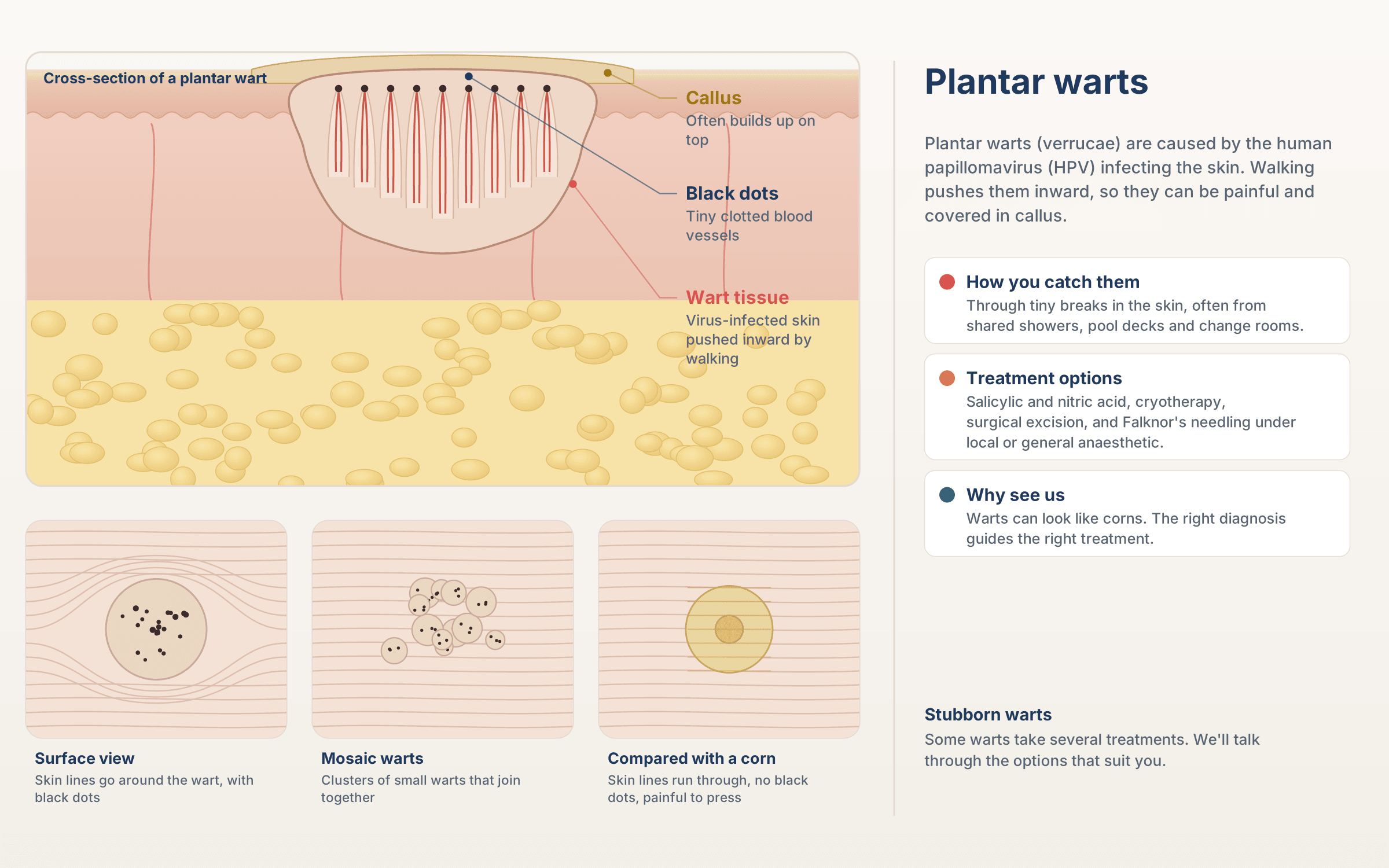
Plantar warts (verrucae) are small growths on the sole of the foot caused by the human papillomavirus (HPV). The virus enters through tiny cuts or breaks in the skin and makes the skin cells grow faster, forming a rough, thickened lump. On the sole, body weight pushes the wart inward, so it often has a layer of hard skin over it and can feel like a stone in your shoe.
Types of plantar wart
- Solitary wart: a single wart, which may grow larger over time
- Mosaic warts: a cluster of many small warts close together, which can be harder to treat
- Kissing warts: warts on neighbouring surfaces, such as between the toes
How do you catch plantar warts?
- Walking barefoot in warm, damp shared areas, such as pool decks, change rooms and showers
- Broken or soft skin, including cracked heels and sweaty feet
- Direct contact with a wart, including picking or scratching your own warts, which spreads them
- A weaker immune system
- Children and teenagers are more commonly affected
Not everyone exposed to the virus develops warts, and many warts eventually go away on their own as the immune system recognises them, although this can take months or years.
Symptoms to look out for
- A small, rough, grainy lump on the sole of the foot
- Tiny black dots in the wart, which are small clotted blood vessels
- Hard skin over the wart, sometimes looking like a corn
- Pain when walking or standing, often worse when the wart is squeezed from the sides
- Skin lines (fingerprint-like ridges) that go around, rather than through, the lesion
- New warts appearing nearby
How are plantar warts diagnosed?
Plantar warts are usually diagnosed by examination. Your podiatrist will gently pare back the overlying hard skin, which reveals the characteristic black dots and pinpoint bleeding of a wart. This also helps distinguish a wart from a corn, which can look similar but is treated differently. In the rare case that a lesion looks unusual, we may recommend a biopsy.
Our treatment options
There’s no single treatment that works for everyone, so we tailor the approach to the size, number and location of the warts and how long you’ve had them. Treatment is usually combined with regular debridement, paring back the hard skin so treatments reach the wart.
Conservative treatments
- Acid treatments: mild to strong acids, including salicylic acid and nitric acid, are applied in the clinic to break down the wart tissue. These are usually repeated over several visits, sometimes with home treatment in between.
- Cryotherapy: the wart is frozen to destroy the infected tissue, also usually over a series of treatments.
- Offloading and padding to reduce pain while treatment works.
For stubborn warts
For warts that haven’t responded to conservative care, we offer:
- Surgical excision (curettage): the wart is removed in a single procedure.
- Falknor’s needling: the wart is repeatedly punctured with a fine needle, pushing wart tissue into the deeper skin to stimulate the body’s own immune response against the virus. One treatment often clears the treated wart, and sometimes others nearby.
Both procedures can be performed under local or general anaesthetic. Your podiatrist will explain which option suits your warts, what recovery involves and what it costs before anything is booked.
Preventing warts from spreading
- Wear thongs in communal showers, change rooms and around pools
- Don’t pick, scratch or cut warts
- Keep your feet clean and dry, and change socks daily
- Cover warts with a waterproof dressing when swimming
- Don’t share towels, socks or shoes
- Treat cracked or broken skin promptly
Watch Dr Ozan Amir explain
Dr Ozan Amir has also presented to podiatrists nationally on wart curettage, through the Australian Podiatry Association.
Minor Surgery for Plantar Warts – Curettage
Nitric Acid for the Treatment of Plantar Warts
Plantar Warts FAQs
Many warts eventually go away without treatment, but it can take months or years, and they can spread in the meantime. Treatment is worthwhile if a wart is painful, spreading or affecting your activities.
It depends on the wart. Small, recent warts often respond to acid or cryotherapy, while large, long-standing or stubborn warts may be best treated with excision or Falknor’s needling.
Acid treatments and cryotherapy can cause some discomfort. Excision and Falknor’s needling are done under anaesthetic, so you won’t feel pain during the procedure, although the area will be tender for a few days afterwards.
Yes. The virus spreads through direct contact and on damp surfaces. Covering warts and wearing thongs in shared areas helps protect others.
They can look similar. Warts usually have tiny black dots and hurt when squeezed from the sides, while corns hurt when pressed directly. Your podiatrist can tell the difference.
No, you can book directly. If your appointment is through a Medicare care plan, DVA or another funded program, you’ll need a referral, so check with us when you book.
Serving Manly and the Northern Beaches.
Manly Foot Clinic is at Shop 3/3 Corrie Rd, North Manly NSW 2100. We see patients from Manly, Balgowlah, Freshwater, Dee Why and Brookvale through to Mosman, Neutral Bay, Chatswood and the wider North Shore.