What is a bursa?
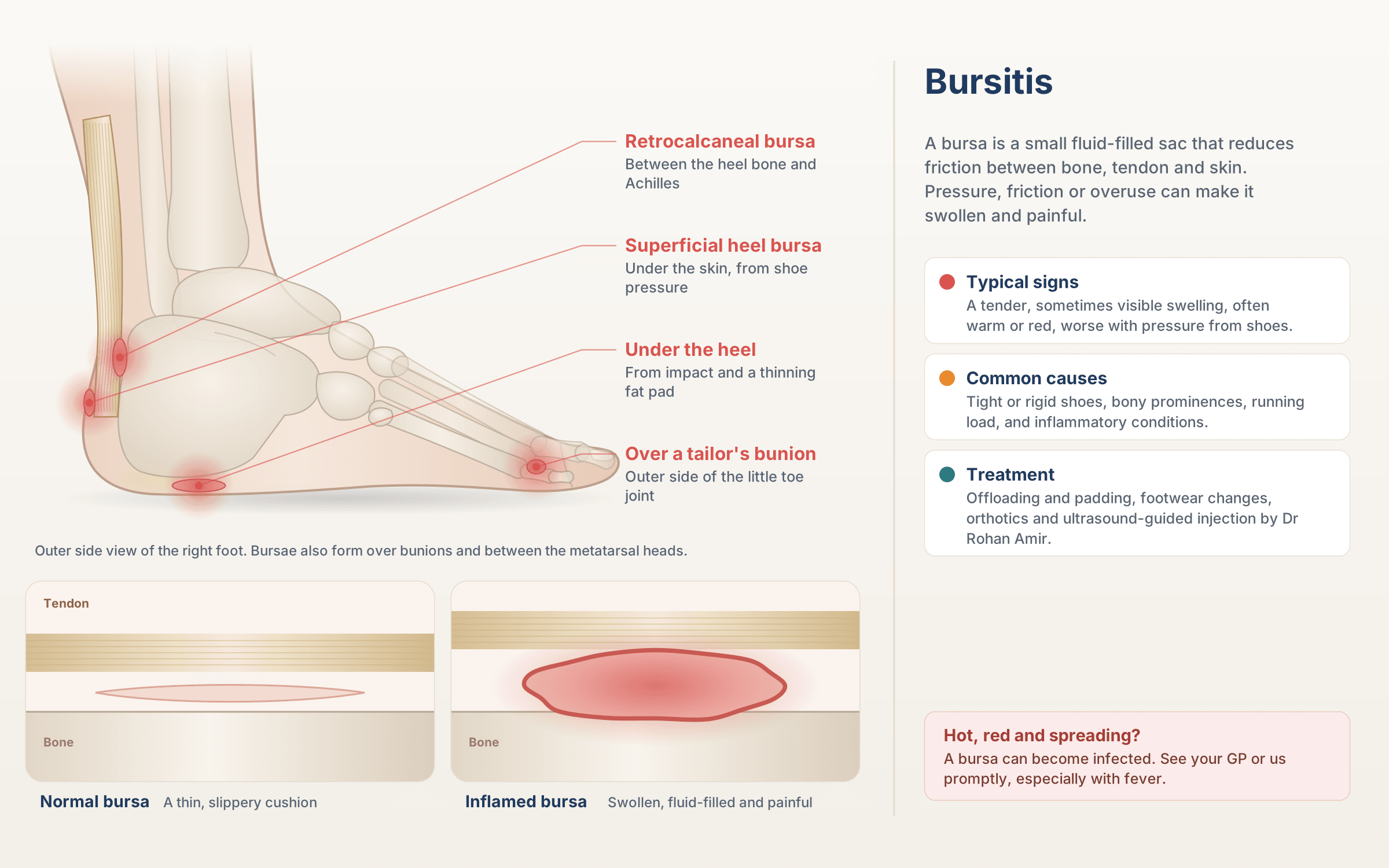
A bursa is a thin sac lined with a slippery membrane and a small amount of fluid. It sits between moving structures, such as a tendon and a bone, so they glide smoothly. Some bursae are present from birth, while others (adventitious bursae) form in response to repeated pressure, such as over a bunion or a bony bump.
When a bursa is irritated by pressure, friction, overuse or injury, it becomes inflamed and fills with extra fluid, causing pain and swelling. This is bursitis.
Common types of foot bursitis
- Retrocalcaneal bursitis: between the Achilles tendon and the heel bone, often with Haglund’s deformity and insertional Achilles pain
- Superficial (Achilles) bursitis: between the skin and the Achilles tendon, often caused by stiff-backed shoes
- Plantar heel bursitis: under the heel bone, which can mimic plantar fasciitis
- Bunion (first metatarsal) bursitis: over the bump of a bunion, from shoe pressure
- Intermetatarsal bursitis: between the metatarsal heads in the forefoot, which can mimic or occur with a Morton’s neuroma
- Bursitis over a tailor’s bunion on the outside of the little toe joint
What causes bursitis?
- Footwear pressure and friction: stiff heel counters, narrow or tight shoes
- Bony prominences: Haglund’s deformity, bunions and tailor’s bunions
- Overuse: repetitive running, jumping or walking
- Foot mechanics: high arches, flat feet and tight calves
- Inflammatory conditions: rheumatoid arthritis and gout
- Injury, such as a direct knock
- Infection, occasionally, through a break in the skin (septic bursitis)
Symptoms to look out for
- Pain and tenderness over a specific spot
- Swelling, which may feel soft and squishy
- Redness and warmth over the area
- Pain when pressure is applied, such as from shoes or walking
- Stiffness or pain with movement of the nearby joint or tendon
Seek prompt care if the area is very red, hot and swollen, you have a fever or feel unwell, or there’s a wound nearby, as this may be an infected bursa.
How is bursitis diagnosed?
Your podiatrist will examine the area to pinpoint which bursa is inflamed, and look for the cause, such as a bony bump, footwear pressure or tight tendon. Ultrasound shows the inflamed, fluid-filled bursa and helps tell bursitis apart from conditions such as plantar fasciitis, Achilles tendinopathy or a neuroma. X-rays show bony prominences such as Haglund’s deformity, and blood tests or fluid analysis may be arranged if gout or infection is suspected.
Settle the inflammation
- Offloading and padding to take pressure off the bursa
- Footwear changes: soft-backed or backless shoes for heel bursitis, and wide, deep shoes for forefoot and bunion bursitis
- Ice and rest from aggravating activities
- Anti-inflammatory medication, in consultation with your GP or pharmacist
Correct the cause
- Custom orthotics, made from a 3D scan of your feet, to change pressure and foot mechanics
- Heel lifts, for retrocalcaneal bursitis, to reduce strain at the back of the heel
- Stretching and strengthening for the calf and foot
- Treating associated conditions, such as Haglund’s deformity, bunions or Achilles tendinopathy
For bursitis that won’t settle
- Ultrasound-guided corticosteroid injection. Dr Rohan Amir can place an injection precisely into the inflamed bursa under ultrasound guidance, avoiding nearby tendons.
- Shockwave therapy, for some cases of chronic heel bursitis, usually over a course of 3 to 5 weekly sessions.
- Surgical opinion. If bursitis keeps returning because of a bony bump, Dr Ozan Amir, Surgical Podiatrist, can assess whether surgery is an option, such as removing the bursa and the bony prominence beneath it, for example in Haglund’s deformity or a bunion.
Watch Dr Ozan Amir explain
Adventitious Bursa – Discussion and Surgical Excision
Surgical Correction of Haglund’s Deformity
Bursitis FAQs
Both can cause heel pain. An ultrasound can show whether the pain is coming from an inflamed bursa or the plantar fascia, which helps guide treatment.
An ultrasound-guided injection into the bursa can settle stubborn bursitis, especially combined with footwear changes and offloading.
It can, if the cause, such as shoe pressure or a bony bump, isn’t addressed. Treating the cause is the key to preventing it returning.
Occasionally, especially if there’s a break in the skin. A bursa that’s very red, hot and swollen, especially with a fever, needs urgent medical attention.
No, you can book directly. If your appointment is through a Medicare care plan, DVA or another funded program, you’ll need a referral, so check with us when you book.
Serving Manly and the Northern Beaches.
Manly Foot Clinic is at Shop 3/3 Corrie Rd, North Manly NSW 2100. We see patients from Manly, Balgowlah, Freshwater, Dee Why and Brookvale through to Mosman, Neutral Bay, Chatswood and the wider North Shore.