What are the sesamoids?
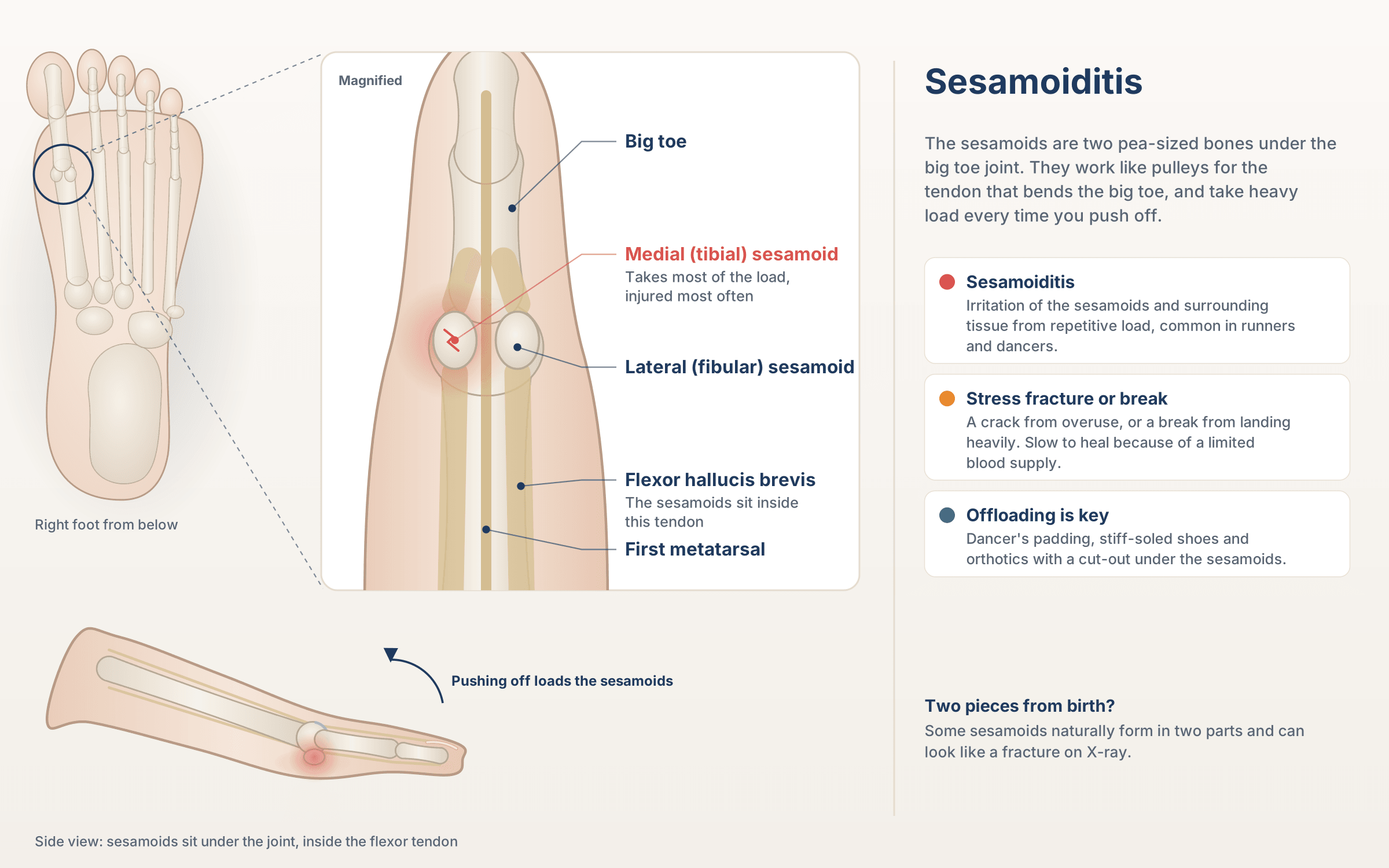
The sesamoids are two small, pea-shaped bones that sit beneath the head of the first metatarsal, under the big toe joint. They lie within the tendon that bends the big toe (flexor hallucis brevis) and work like pulleys, increasing the tendon’s leverage and absorbing load as you push off.
- The medial (tibial) sesamoid, on the inner side, takes most of the load and is injured most often.
- The lateral (fibular) sesamoid sits on the outer side.
Sesamoid problems
- Sesamoiditis: inflammation and irritation of the sesamoids and the tissues around them, from overuse
- Sesamoid stress fracture: a small crack from repetitive loading
- Acute sesamoid fracture: a break from a sudden injury, such as landing heavily
- Turf toe: a sprain of the ligaments around the big toe joint, which can involve the sesamoids
- Sesamoid arthritis: wear of the joint surface between the sesamoids and the metatarsal
Some people are born with a sesamoid in two pieces (a bipartite sesamoid), which can look like a fracture on X-ray. Telling the two apart is part of your assessment.
What causes sesamoid problems?
- Repetitive pressure on the forefoot: running, jumping, dancing (especially ballet), tennis and basketball
- High heels, which push weight onto the ball of the foot
- High arches or a plantarflexed first metatarsal, which increase load under the big toe
- Thin-soled or very flexible shoes
- A sudden injury, such as landing on the forefoot or forcing the big toe upward
- Bunions, which change the position of the sesamoids
Symptoms to look out for
- Pain under the big toe joint, especially when pushing off or walking barefoot
- Pain when bending the big toe upward
- Swelling or bruising under the joint
- Difficulty standing on your toes or wearing heels
- Pain that builds gradually (sesamoiditis or stress fracture) or starts suddenly (fracture)
How are sesamoid problems diagnosed?
Your podiatrist will press over each sesamoid to find the painful spot, check the movement and strength of the big toe, and assess your foot structure and how you walk. X-rays, including a special view of the sesamoids, help identify fractures and arthritis. Because an early stress fracture may not show on X-ray, and a bipartite sesamoid can look like a fracture, we arrange an MRI or CT scan when the diagnosis isn’t clear.
Offload the sesamoids
- Padding: a dancer’s pad or cut-out pad that takes pressure off the painful sesamoid
- Strapping to limit how far the big toe bends upward
- Footwear: stiff-soled or rocker-soled shoes with good cushioning, and a break from heels
- Activity changes: reducing running, jumping and dancing while it settles, with low-impact alternatives
- A walking boot, for a few weeks, for fractures or severe pain
Correct the cause
- Custom orthotics, made from a 3D scan of your feet, with a cut-out or recess under the sesamoids to take pressure off them long term
- Calf stretching and foot strengthening
- A gradual return to activity once the pain settles
For pain that won’t settle
- Ultrasound-guided injection. Where inflammation around the sesamoid is contributing, Dr Rohan Amir can place an injection precisely under ultrasound guidance.
- Shockwave therapy for long-standing sesamoiditis, usually over a course of 3 to 5 weekly sessions.
- Surgical opinion. If a sesamoid fracture doesn’t heal, or pain continues despite months of thorough treatment, Dr Ozan Amir, Surgical Podiatrist, can assess whether surgery is an option. This may involve removing all or part of the painful sesamoid (sesamoidectomy).
How long does it take to recover?
Sesamoiditis often settles over 6 to 12 weeks with good offloading. Sesamoid fractures heal slowly because the bones have a limited blood supply, and can take several months. Returning to full activity too early is the most common reason for setbacks.
Watch Dr Ozan Amir explain
Fracture of the Fibular Sesamoid of the Great Toe – Anatomy and Surgical Excision
Thirteen Weeks After Fibular Sesamoid Excision – Post-operative Recovery
First Metatarsophalangeal Joint Injuries – Splinting Using the Valguloc II Brace
Sesamoiditis FAQs
They can feel similar. Sesamoiditis usually builds up gradually, while a fracture may follow an injury. X-rays help, but an MRI or CT is sometimes needed, especially to tell a fracture apart from a sesamoid that naturally formed in two pieces.
Usually not at full intensity while it’s painful. We’ll adjust your training and suggest low-impact alternatives so you can stay active while it heals.
Yes. Orthotics with a cut-out under the sesamoids are one of the most effective ways to offload them and prevent the problem returning.
Most sesamoid problems settle with offloading. Surgery is only considered when a fracture won’t heal, or pain persists despite thorough treatment.
No, you can book directly. If your appointment is through a Medicare care plan, DVA or another funded program, you’ll need a referral, so check with us when you book.
Serving Manly and the Northern Beaches.
Manly Foot Clinic is at Shop 3/3 Corrie Rd, North Manly NSW 2100. We see patients from Manly, Balgowlah, Freshwater, Dee Why and Brookvale through to Mosman, Neutral Bay, Chatswood and the wider North Shore.